★
Loading archive…
Loading archive…
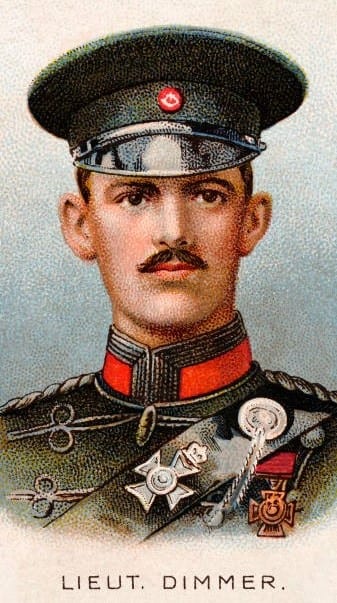
Lieutenant Colonel, British Army
Support & adopt this hero ↓
Shot five times, he kept his machine gun firing at the enemy
Lieutenant Colonel John Henry Stephen “Jack” Dimmer (1883–1918) was a British Army officer whose Victoria Cross action at Klein Zillebeke became one of the best-known acts of courage in the opening months of the First World War. Raised in Wimbledon, he won a scholarship to Rutlish Science School and joined the King’s Royal Rifle Corps in 1902. His early service included South Africa after the Boer War had ended, and intelligence work; in 1908 he received a commission and undertook special duties in West Africa for the Colonial Office. When war began, he returned to the 2nd Battalion, King’s Royal Rifle Corps, and went to France with the British Expeditionary Force. At Klein Zillebeke in Belgium he commanded a machine-gun section during the First Battle of Ypres.
On 12 November 1914, a heavy German bombardment was followed by an attack by the Prussian Guard. Shellfire destroyed one of Dimmer’s machine guns and killed or wounded most of the section. Though injured, he kept firing another gun, at times working it alone. Twice he climbed out of the emplacement to clear stoppages in its wet ammunition belt and was shot each time. Shrapnel wounded him again, but he continued to engage the advancing Germans, who came within roughly 50 yards of the British trenches. His sustained fire helped break up the attack. German artillery wounded him again as the enemy withdrew, and the gun was ultimately destroyed. Dimmer had been hit five times. He insisted on reporting personally to brigade headquarters before accepting treatment.
While recovering, Dimmer learned that he had been awarded the Victoria Cross. King George V presented it to him in January 1915, alongside the Military Cross. Dimmer later served in Salonika and returned to the Western Front, where he commanded the 2/4th Battalion, Royal Berkshire Regiment. He was killed on 21 March 1918 near Marteville while leading his men during the German Spring Offensive. He had mounted his horse to lead the battalion’s counterattack and was struck by a bullet while giving orders. His body was recovered after the war and buried at Vadencourt British Cemetery. His Victoria Cross and other medals are held by the Royal Green Jackets (Rifles) Museum.
The Victoria Cross citation records that Dimmer continued to serve his machine gun during the attack at Klein Zillebeke until he had been wounded five times, and remained at his post until the weapon was destroyed. It notes that his continued fire drove the attackers back and that he reported to brigade headquarters despite his injuries. The citation was published in The London Gazette, issue 28980, 17 November 1914.
Sources: Royal United Services Institute, “Lieutenant John Henry Stephen Dimmer - The Victoria Cross, RUSI and the First World War, Part VI”; Merton Council, “John Dimmer VC - Carved in Stone”; National Army Museum, “‘Capt. J.H.S. Dimmer, V.C.’, cigarette card, 1915”; The London Gazette, issue 28980, 17 November 1914, Victoria Cross citation for Lieutenant John Henry Stephen Dimmer.
[Biographical and award record](https://victoriacross.org.uk/bbdimmer.htm)
Become the named supporter for this profile and edit the tribute biography and portrait (Owner account required). Proceeds help keep the archive online.
$25 USD / year — annual sponsorship renewal. Keeps the page online and, where enabled, the family anniversary remembrance emails active.