★
Loading archive…
Loading archive…

He saved his wounded commander and held the captured ground.
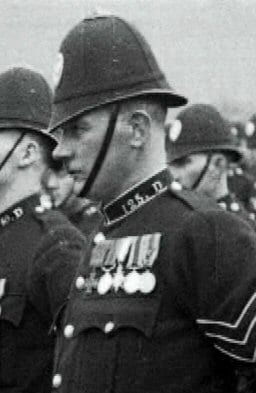
John McAulay was born at Kinghorn, Fife, on 27 December 1888. He worked as a miner before joining Glasgow City Police in 1911. An accomplished boxer, he became the force's heavyweight champion. He enlisted in the Scots Guards in September 1914 and served in France from January 1915, rising through the non-commissioned ranks.
On the opening day of the Third Battle of Ypres in July 1917, McAulay took over his platoon after its officer was killed. His work against German pillboxes and snipers earned the Distinguished Conduct Medal. He subsequently distinguished himself again at Fontaine Notre Dame during the Battle of Cambrai.
On 27 November 1917, with the company's officers casualties, he assumed command and reorganized the men under shell and machine-gun fire. He recognized an approaching counter-attack and used the available machine guns to repulse it. At the same time he carried his gravely wounded company commander to safety. His actions preserved the gains already made and enabled the survivors to hold their position. King George V presented his Victoria Cross in March 1918.
McAulay later became a company sergeant major and returned to Glasgow Police after demobilization in January 1919. Promotion in the force followed, eventually making him an inspector. His first wife, Isabella Horn, and their infant son died shortly after the child's birth in December 1920. He married Catherine Thomson in 1923, and they had a daughter.
He continued police service through the interwar years and the Second World War, retiring in the 1940s. He remained involved in veterans' commemorations and attended the 1946 victory events in London. McAulay died in Glasgow on 14 January 1956 and was buried in New Eastwood Cemetery. His decorations combine repeated gallantry awards with service medals spanning both world wars and three royal commemorations.
Official Victoria Cross citation:
For most conspicuous bravery and initiative in attack. When all his officers had become casualties Serjt. McAulay assumed command of the company and under shell and machine-gun fire successfully held and consolidated the objective gained. He reorganised the company, cheered on and encouraged his men, and under heavy fire at close quarters showed utter disregard of danger. Noticing a counter-attack developing on his exposed left flank, he successfully repulsed it by the skilful and bold use of machine-guns, aided by two men only, causing heavy enemy casualties. Serjt. McAulay also carried his company commander, who was mortally wounded, a long distance to a place of safety under very heavy fire. Twice he was knocked down by the concussion of a bursting shell, but, nothing daunted, he continued on his way until his objective was achieved, killing two of the enemy who endeavoured to intercept him. Throughout the day this very gallant Non-commissioned Officer displayed the highest courage, tactical skill, and coolness under exceptionally trying circumstances.
Become the named supporter for this profile and edit the tribute biography and portrait (Owner account required). Proceeds help keep the archive online.
$25 USD / year — annual sponsorship renewal. Keeps the page online and, where enabled, the family anniversary remembrance emails active.