★
Loading archive…
Loading archive…
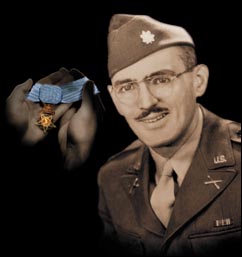
Lieutenant Colonel, U.S. Army
Support & adopt this hero ↓
Lieutenant Colonel John Upshur Dennis Page spent the final twelve days of his life repeatedly choosing danger over safety during the Battle of Chosin Reservoir , a sustained display of courage that would ultimately make him one of the most remarkable American heroes of the Korean War and earn him both the Medal of Honor and Navy Cross . Page was born on February 8, 1904, on Malahi Island, Luzon, in the Philippine Islands, the son of a Regular Army officer. He later grew up in St. Paul, Minnesota. Page dreamed of attending the United States Military Academy at West Point, but eyesight requirements prevented him from doing so. Instead, he attended Princeton University, graduating in 1926 with an engineering degree and an ROTC commission. That same year, he was commissioned as a Field Artillery officer in the Organized Reserve.
Page was called to active duty in 1942 during World War II . An experienced artilleryman and instructor, he initially served at Fort Sill, Oklahoma, before successfully securing the combat assignment he wanted. He was sent to Europe, where he commanded an artillery battalion and served in Germany. After World War II, Page received a commission in the Regular Army and continued his career as a professional Field Artillery officer.
When the Korean War began in 1950, Page received orders to teach at the Command and General Staff College at Fort Leavenworth, Kansas . Rather than remain in the United States, he sought an overseas combat assignment and succeeded in being sent to Korea. Assigned to X Corps Artillery , Page was attached to the 52d Transportation Truck Battalion while awaiting the opportunity to assume command of an artillery battalion.
On November 29, 1950, Page left X Corps headquarters at Hamhung with the mission of establishing traffic-control points along the main supply route leading toward positions of the 1st Marine Division and Army elements on the Chosin Reservoir plateau. Once the mission was completed, he was free to return to the relative safety of Hamhung. Instead, Page chose to remain forward to assist an isolated signal station. When Chinese forces severed the route, he was cut off with elements of the Marine division. After breaking up an ambush and rescuing his jeep driver near a destroyed bridge, Page made his way to the surrounded Marine garrison at Koto-ri .
At Koto-ri, Page gathered Army personnel who had become trapped with the Marines and organized them into an effective reserve force. He repeatedly exposed himself to enemy fire while helping defend the perimeter and supporting efforts to complete an improvised airstrip needed to evacuate casualties. During attacks on the airstrip, Page directed defensive fire from exposed ground and twice climbed onto the rear deck of a tank, manning its machine gun to drive attacking forces away from the position.
On December 3, Page took his fight directly over enemy-held territory. Flying at low altitude in a light observation aircraft, he dropped hand grenades on Chinese positions and fired his carbine into enemy foxholes below. It was another episode in an extraordinary series of actions carried out during nearly continuous combat around the Chosin Reservoir , where Page repeatedly went beyond the requirements of his assignment to support the surrounded Marines and soldiers.
After approximately ten days of constant fighting, Page was flown back to Hamhung to arrange artillery support for the forces attempting to break out from the reservoir area. Once again, he had the opportunity to remain in relative safety. Once again, he returned to the fighting. As the Marines and soldiers withdrew southward, Page joined the rear guard and repeatedly engaged enemy forces threatening the column. He manned the machine gun of an abandoned tank to cover passing vehicles, then later carried another machine gun onto an exposed hillside and delivered counterfire while troops and vehicles moved through an ambush.
On the night of December 10, 1950 , the withdrawing column was halted near Sudong-ni by a powerful enemy blocking force while hostile fire struck from the front and both flanks. Recognizing the danger to the immobilized convoy, Page fought his way toward the head of the column and advanced directly into the enemy position. His attack threw the hostile force into disorder and gave the convoy an opportunity to regroup and resist the assault. Even after the Marine accompanying him was wounded and ordered back, Page continued forward alone. He remained at close range, engaging the enemy until he was mortally wounded. Lieutenant Colonel John U.D. Page was 46 years old.
For his extraordinary heroism during the final action near Sudong-ni on December 10, Page was posthumously awarded the Navy Cross , one of the United States military's highest decorations for valor. His wider series of actions from November 29 through December 10, 1950, was later recognized with the Medal of Honor . The Medal of Honor was presented to his widow on April 2, 1957, and Page's award was officially recorded in General Orders No. 21, dated April 25, 1957 . Together, the two decorations document an extraordinary period of sustained combat heroism during the Chosin Reservoir campaign.
Lieutenant Colonel John Upshur Dennis Page, Medal of Honor recipient and veteran of the Battle of Chosin Reservoir , is buried at Arlington National Cemetery, Section 4, Site 2743-B . His legacy continued far beyond the battlefield. Camp Page in Chuncheon, South Korea, bore his name, and the Military Sealift Command vessel MV LTC John U.D. Page (T-AK 4543) continues the association of his name with American military service. More than seven decades after his death, Page remains remembered for a remarkable pattern of leadership and self-sacrifice: when offered safety, he repeatedly chose to return to the men still fighting.
Become the named supporter for this profile and edit the tribute biography and portrait (Owner account required). Proceeds help keep the archive online.
$25 USD / year — annual sponsorship renewal. Keeps the page online and, where enabled, the family anniversary remembrance emails active.