★
Loading archive…
Loading archive…
Sergeant, British Army
Support & adopt this hero ↓
Taking command under fire, he led the company farther ahead.
John William Ormsby was born at Dewsbury, Yorkshire, on 11 January 1881. His father worked as a licensed hawker. Ormsby entered the army in 1899 and served overseas before returning to Britain and civilian life. He married Catherine Burns in 1908 and became the father of two surviving sons.
At the outbreak of the First World War he returned to military service and reached France in November 1914. He served with the 2nd Battalion, King's Own Yorkshire Light Infantry, and received the Military Medal in 1916.
On 14 April 1917, near Fayet, his company advanced under heavy rifle and machine-gun fire. Acting as company sergeant major, Ormsby helped clear the village and pressed on against snipers in positions beyond it.
When the only surviving officer was wounded, he took command. He led the company approximately 400 yards farther forward and established a new position, which the men held until relieved. His Victoria Cross recognised the example and direction that enabled the company to continue despite the loss of its officers.
King George V presented the cross at Buckingham Palace in June 1917. Ormsby remained in the army until demobilisation in April 1919. Support from his home community included a horse and cart and money invested to help him begin work as a greengrocer.
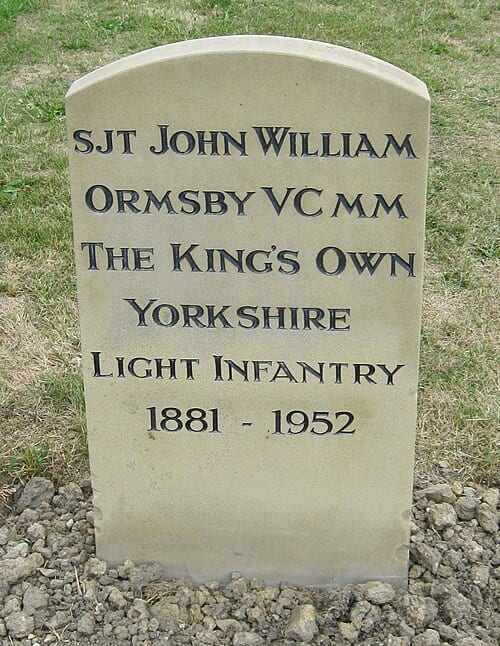
He later worked for the local corporation. He also coached boys in boxing and rugby and ran the Ormsby Boxing Troupe. He died at Dewsbury in July 1952 and was buried there following a requiem mass at St Paulinus. A later headstone and a road bearing his name commemorate his service.
Official Victoria Cross citation
For most conspicuous bravery and devotion to duty during operations which culminated in the capture of an important position. Acting as Company Serjeant-Major he showed throughout the attack absolute indifference to the heavy machine gun and rifle fire, and set a fine example. After clearing the village he pushed on and drove out many snipers from localities further forward. When the only surviving officer was wounded he took command of the company and led them forward under heavy fire for 400 yards to a new position. He organised his new position with great skill and held his line with determination until relieved of his command. His conduct throughout was admirable and inspired confidence in every man under his command.
Second Supplement to The London Gazette of 8 June 1917. 8 June 1917, Numb. 30122, p. 5704
Become the named supporter for this profile and edit the tribute biography and portrait (Owner account required). Proceeds help keep the archive online.
$25 USD / year — annual sponsorship renewal. Keeps the page online and, where enabled, the family anniversary remembrance emails active.