★
Loading archive…
Loading archive…
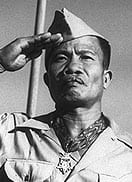
Captain, U.S. Army
Support & adopt this hero ↓
What makes a soldier abandon the safety of his position and run straight into a storm of enemy artillery fire? On January 16, 1942, during the desperate Battle of Bataan, Sergeant Jose Cabalfin Calugas Sr. answered that question with extraordinary courage. Armed with determination rather than a weapon, he crossed 1,000 yards of shell-swept ground to save a shattered artillery position. His actions would earn him the Medal of Honor, America's highest military decoration for valor, and secure his place among the great heroes of World War II.
Born on December 29, 1907, in Leon, Iloilo, on the Philippine island of Panay, Jose Calugas grew up in a modest farming family before joining the Philippine Scouts of the United States Army in 1930. Trained as an artilleryman, he eventually served as a mess sergeant with Battery B, 88th Field Artillery Regiment. When Japanese forces invaded the Philippines in December 1941, Calugas found himself defending his homeland against a powerful enemy.
On January 16, 1942, near Culis, Bataan, Japanese bombardment disabled an American artillery gun, killing or wounding its entire crew. Witnessing the devastation, Calugas made a remarkable decision. Without waiting for orders, he raced across open ground under relentless shellfire, gathered a volunteer crew, and restored the weapon to action. Despite continued Japanese bombardment, his improvised team resumed effective fire against the enemy. His official Medal of Honor citation specifically recognized that he acted "voluntarily and without orders," demonstrating extraordinary bravery when every moment could have been his last. His heroism was formally recognized under War Department General Orders No. 10, dated February 24, 1942.
Yet Calugas's greatest trials were far from over. Following the fall of Bataan in April 1942, he was captured by Japanese forces and forced to endure the infamous Bataan Death March. He survived brutal imprisonment and was later assigned to forced labor at a rice mill. Rather than surrender his commitment to freedom, he secretly gathered intelligence for Filipino resistance fighters. Escaping in October 1943, he joined the guerrilla movement and continued fighting the Japanese occupation, including renewed operations on Luzon during the Allied liberation of the Philippines in 1945.
On April 30, 1945, more than three years after his extraordinary battlefield action, Calugas finally received the Medal of Honor from Major General Richard J. Marshall at Camp Olivas, Pampanga. His wartime service was also recognized through the Asiatic-Pacific Campaign Medal, World War II Victory Medal, Philippine Liberation Ribbon, and Prisoner of War Medal. His unit's distinguished combat record was acknowledged through the Distinguished Unit Citation, later renamed the Army Presidential Unit Citation, with two oak leaf clusters representing three awards, as recorded in a February 1998 Congressional tribute. His broader service also qualified him for the American Defense Service Medal and Philippine Defense Medal.
Calugas continued serving after the war, including occupation duty on Okinawa with the 44th Infantry Regiment, service reflected in his Army of Occupation Medal. His subsequent military career also qualified him for the National Defense Service Medal. He became a naturalized American citizen and retired from the United States Army in 1957 with the rank of captain. Settling in Tacoma, Washington, he pursued higher education, earned a business administration degree, and worked for Boeing.
Jose Cabalfin Calugas Sr. died on January 18, 1998, at the age of 90. Remembered as the first Filipino to receive the Medal of Honor for heroism during World War II, he left a legacy extending far beyond a single act of bravery. From the artillery positions of Bataan to the horrors of Japanese captivity and the struggle for Philippine liberation, his life demonstrated that courage is not simply the absence of fear. It is the willingness to act when everything is at stake.
Become the named supporter for this profile and edit the tribute biography and portrait (Owner account required). Proceeds help keep the archive online.
$25 USD / year — annual sponsorship renewal. Keeps the page online and, where enabled, the family anniversary remembrance emails active.