★
Loading archive…
Loading archive…
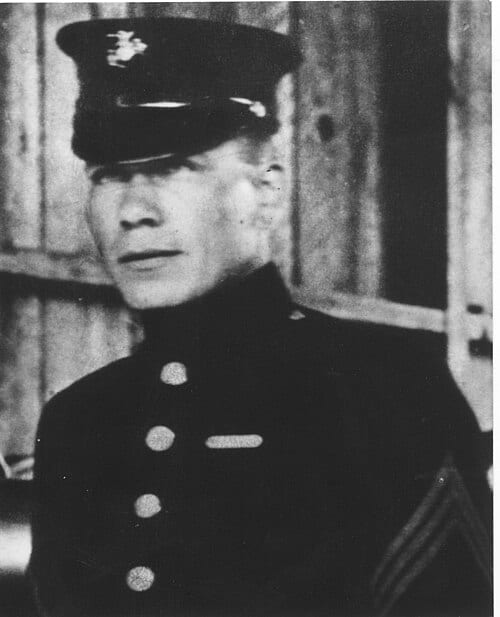
Private, U.S. Marine Corps
Support & adopt this hero ↓
Twice wounded and still refusing to leave his machine gun, Joseph Anthony Glowin earned the Medal of Honor in one of the most intense actions of the 1916 Dominican campaign. At Guayacanas, when Marines faced a strongly entrenched enemy force, Glowin continued firing after being struck by enemy fire, remaining at his position until he was wounded a second time and his comrades were forced to carry him to safety.
Joseph Anthony Glowin was born in Detroit, Michigan, on 14 March 1892 and enlisted in the United States Marine Corps in December 1913. His early service took him to the Vera Cruz expedition in Mexico in 1914, followed by combat operations in Haiti during 1915. In 1916, Glowin deployed to the Dominican Republic with the 13th Company, Artillery Battalion, 1st Brigade, serving as a machine gunner during the Marine advance through Santo Domingo.
On 3 July 1916, near Guayacanas, Dominican Republic, Glowin's unit encountered a heavily entrenched enemy force. With the Marines exposed and facing intense fire, Glowin positioned his machine gun behind a fallen log and opened fire on the enemy trenches. He was struck once but continued operating his weapon. After being hit a second time, he was dragged from the position by fellow Marines. His extraordinary heroism and conspicuous courage in the presence of the enemy earned him the Medal of Honor, recognizing his actions during the engagement.
Glowin remained in the Dominican Republic until June 1917 and later reenlisted for service during World War I. His wartime record reflects service connected with the Dominican Republic and the West Indies, followed by continued Marine Corps service until September 1919. Although he temporarily held the rank of Gunnery Sergeant, those promotions were temporary, and he was ultimately discharged at his permanent rank of Private.
His military career included the Haitian Campaign of 1915, the Dominican Campaign of 1916, the subsequent Marine Corps expeditionary operations in the Dominican Republic, and World War I service represented by the West Indies clasp on his Victory Medal. Together, these campaigns reveal a Marine whose career spanned some of the United States Marine Corps' important expeditionary operations of the early twentieth century.
After leaving the Marine Corps, Glowin continued his life of public service with the Detroit Police Department, where he served from 1923 until 1941. He died on 23 August 1952 and was buried at Mount Olivet Cemetery in Detroit, Michigan.
Joseph Anthony Glowin's legacy rests not simply on the Medal of Honor he received, but on the courage behind it. At Guayacanas, he was wounded, returned to the fight, and remained at his weapon until he could fight no longer. His story stands as a powerful example of Marine courage, perseverance, and devotion to duty under fire.
Become the named supporter for this profile and edit the tribute biography and portrait (Owner account required). Proceeds help keep the archive online.
$25 USD / year — annual sponsorship renewal. Keeps the page online and, where enabled, the family anniversary remembrance emails active.