★
Loading archive…
Loading archive…

He drew enemy fire so his trapped platoon could reach safety
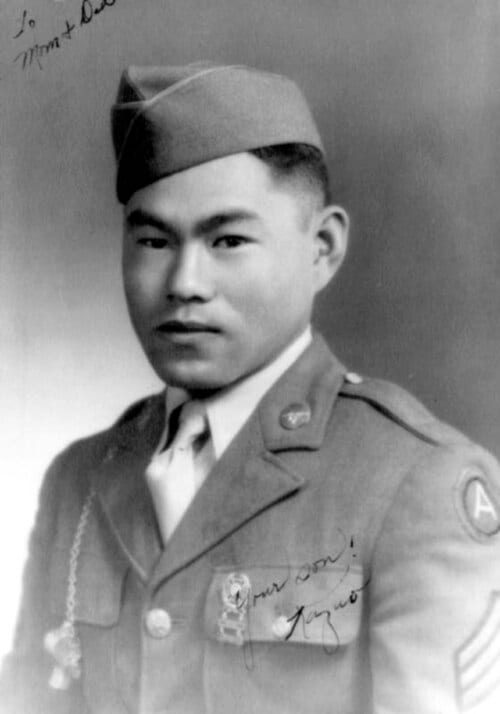
Kazuo Otani was born at Sanger, California, on 2 June 1918 to Japanese immigrant parents. He entered the United States Army in February 1942. While he served, members of his family were confined at the Gila River relocation camp under the government's wartime removal policy towards Japanese Americans.
He volunteered for the 442nd Regimental Combat Team, the segregated Japanese American formation trained for overseas service. By July 1944 he was a staff sergeant in Company G, 2nd Battalion, fighting in Italy.
On 15 July near Pieve di Santa Luce, his platoon was pinned in a wheat field by machine guns and snipers. Otani left cover and killed a sniper. He then repeatedly moved across exposed ground, directing the men towards shelter at the foot of a cliff and drawing fire away from them.
After organising those who had reached safety, he returned towards the remaining men and directed covering fire. Seeing a seriously wounded soldier in the open, he ordered others to remain under cover and crawled out to him. He dragged the man into a shallow ditch and began giving first aid, but was mortally wounded by machine-gun fire.
He was twenty-six. His conduct initially brought the Distinguished Service Cross. He was buried in Veterans Liberty Cemetery at Fresno, where his family and community preserved his memory.
A review of decorations awarded to Asian American soldiers during the Second World War led to the upgrading of his award to the Medal of Honor. President Bill Clinton presented it to his family at the White House on 21 June 2000. The recognition joined the record of his battlefield leadership with the history of a family that had faced exclusion and confinement while he served.
Official Medal of Honor citation
For conspicuous gallantry and intrepidity at risk of his life above and beyond the call of duty. Staff Sergeant Kazuo Otani distinguished himself by extraordinary heroism in action on 15 July 1944, near Pieve Di S. Luce, Italy. Advancing to attack a hill objective, Staff Sergeant Otani's platoon became pinned down in a wheat field by concentrated fire from enemy machine gun and sniper positions.
Realizing the danger confronting his platoon, Staff Sergeant Otani left his cover and shot and killed a sniper who was firing with deadly effect upon the platoon. Followed by a steady stream of machine gun bullets, Staff Sergeant Otani then dashed across the open wheat field toward the foot of a cliff, and directed his men to crawl to the cover of the cliff. When the movement of the platoon drew heavy enemy fire, he dashed along the cliff toward the left flank, exposing himself to enemy fire.
By attracting the attention of the enemy, he enabled the men closest to the cliff to reach cover. Organizing these men to guard against possible enemy counterattack, Staff Sergeant Otani again made his way across the open field, shouting instructions to the stranded men while continuing to draw enemy fire. Reaching the rear of the platoon position, he took partial cover in a shallow ditch and directed covering fire for the men who had begun to move forward.
At this point, one of his men became seriously wounded. Ordering his men to remain under cover, Staff Sergeant Otani crawled to the wounded soldier who was lying on open ground in full view of the enemy. Dragging the wounded soldier to a shallow ditch, Staff Sergeant Otani proceeded to render first aid treatment, but was mortally wounded by machine gun fire.
Staff Sergeant Otani's extraordinary heroism and devotion to duty are in keeping with the highest traditions of military service and reflect great credit on him, his unit, and the United States Army.
Become the named supporter for this profile and edit the tribute biography and portrait (Owner account required). Proceeds help keep the archive online.
$25 USD / year — annual sponsorship renewal. Keeps the page online and, where enabled, the family anniversary remembrance emails active.