★
Loading archive…
Loading archive…
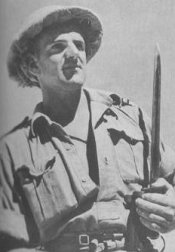
Second Lieutenant, New Zealand Army
Support & adopt this hero ↓
eith Elliott VC was one of New Zealand’s great Second World War soldiers: a farm boy from Āpiti who became a battle-hardened infantryman, a Victoria Cross recipient, and later an Anglican priest whose ministry was as blunt, practical, and human as the man himself.
Born at Āpiti, New Zealand, on 25 April 1916, Elliott was working as a farmer when the Second World War began. He enlisted in the 2nd New Zealand Expeditionary Force and served with the 22nd New Zealand Battalion, seeing hard fighting in Greece, Crete, and North Africa. By July 1942 he was a sergeant and platoon commander during the First Battle of El Alamein.
His Victoria Cross was earned at Ruweisat Ridge, Egypt, on 15 July 1942. At dawn, his battalion was attacked on three sides by German tanks and came under intense shell, machine-gun, and mortar fire. Elliott led his platoon across exposed ground to cover, despite being wounded in the chest. He then re-formed his men and led them forward again. With only seven men, he charged across open ground with the bayonet, capturing four machine-gun posts and an anti-tank gun, taking about 50 prisoners. When another enemy machine-gun post opened fire from the flank, Elliott attacked it alone, killing several of the enemy and taking further prisoners. By the end of the action he had been wounded four times, yet refused to leave his men until he had handed over 130 prisoners and arranged for the survivors to rejoin the battalion.
The London Gazette citation praised his “quick grasp of the situation, great personal courage and leadership.” New Zealand History confirms that Elliott received the Victoria Cross in Egypt in 1942 for his bravery at Ruweisat Ridge; his VC ribbon was presented by Field Marshal Bernard Montgomery.
Elliott was later commissioned as a second lieutenant in May 1943, sent home to New Zealand, and discharged from the army later that year. In February 1944 he married Margaret Rachel Markham at Hastings. They would raise five children. His postwar life might have followed the ordinary pattern of farming and family, but Elliott took an unexpected turn. Encouraged by former army chaplain Michael Underhill, he entered the Anglican ministry, training at College House, Christchurch. He was ordained deacon in 1947 and priest in 1948.
As a clergyman, Elliott was never polished in the conventional sense. He was direct, impulsive, sometimes difficult, but deeply practical. He served at All Saints’, Palmerston North, worked with the Wellington City Mission, and later held rural and Māori pastorates. His style of ministry was earthy and hands-on: he helped sick parishioners by milking their cows, raised funds by collecting rags, dags, and beer bottles, and once reportedly wheeled a bicycle into church during a sermon to make the point that he needed a car.
In 1967 he published his autobiography, From Cowshed to Dogcollar, a title that neatly captured the unlikely arc of his life: farmer, soldier, hero, priest. For decades he remained a familiar Anzac Day speaker, often spending his birthday away from home in service to remembrance.
Keith Elliott died of cancer on 7 October 1989 at Te Omanga Hospice, Lower Hutt, and was buried at Paraparaumu Cemetery with full military honours. His medals are held at the Queen Elizabeth II Army Memorial Museum, Waiouru.
Become the named supporter for this profile and edit the tribute biography and portrait (Owner account required). Proceeds help keep the archive online.
$25 USD / year — annual sponsorship renewal. Keeps the page online and, where enabled, the family anniversary remembrance emails active.