Loading archive…
Loading archive…

Jemadar, British Indian Army
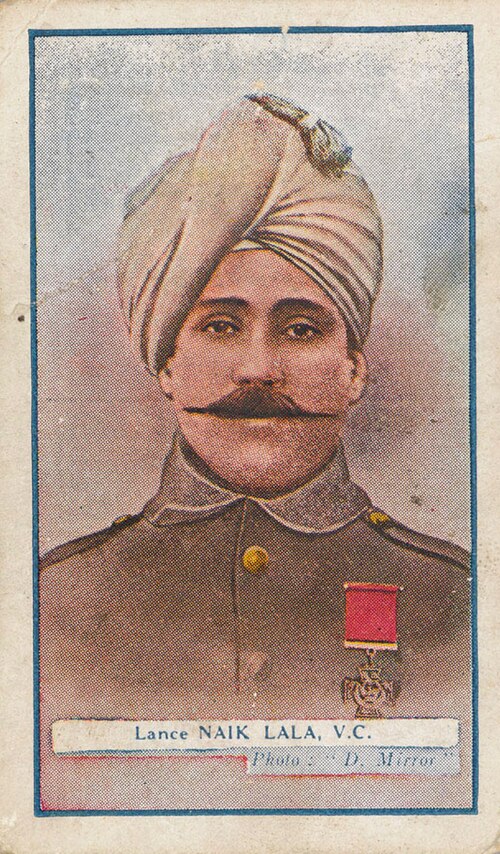
Support & adopt this hero ↓Lala Ram (20 April 1876 – 23 March 1927) was an Indian soldier in the British Indian Army who received the Victoria Cross, the premier award for gallantry in the presence of the enemy, awarded to British and Commonwealth forces. Born in Parol village, Hamirpur, within the Kangra district of Punjab province, he was the son of Dhinga, a first-grade zamindar. He possessed basic literacy in Hindi and excelled in athletics, becoming a prominent football player for his unit. On 20 February 1901, he enlisted under service number 501 in the newly raised 41st (Dogra) Regiment of Bengal Infantry at Jalandhar. He deployed with the battalion to the China coast between 1904 and 1908 before returning to garrison duty in India.
At the outbreak of the First World War, the 41st Dogras deployed to the Middle East as part of the Indian Expeditionary Force, initially guarding the Suez Canal Zone in Egypt. The regiment subsequently moved to the Western Front in France, joining the Indian Corps. Lala served in heavy trench combat at the Battle of Neuve Chapelle and the Battle of Festubert in 1915. After sustaining combat injuries in France, he was evacuated to England and received treatment at the Brighton Pavilion military hospital. After his recovery, he rejoined the 41st Dogras in Mesopotamia, where Indian Expeditionary Force D was operating along the Tigris River. His unit joined the relief column attempting to break the Ottoman siege of Major-General Charles Townshend's garrison at Kut-al-Amara.
On 21 January 1916, during the First Battle of Hanna near Al Orah, Lance Naik Lala performed the actions that earned him the Victoria Cross. The 41st Dogras, operating within the 35th Composite Brigade of the 7th (Meerut) Division, launched an assault across six hundred yards of flooded, exposed ground against heavily fortified Ottoman trenches in pouring rain. The attacking force faced devastating machine-gun and artillery fire, suffering over two thousand casualties. Finding a wounded officer of another unit lying exposed near the Ottoman lines, Lala dragged him into an improvised trench he had dug himself, where he had already dressed the wounds of four fallen comrades. Hearing calls for assistance from Captain E. H. Nicholson of the 37th Dogras, Lala crawled out under direct fire, bandaged his injuries, and dragged him to the temporary shelter.
Lala then heard cries from Lieutenant R. A. Lindop, the Adjutant of the 41st Dogras, who lay severely wounded within one hundred yards of the enemy parapet. Disregarding warnings from his comrades, Lala crawled through direct rifle fire to reach the officer. When Lieutenant Lindop refused to be carried back immediately due to the high probability of both men being killed, Lala stripped off his own heavy tunic to cover the freezing officer and remained at his side in the mud until darkness fell. After nightfall, he carried Lieutenant Lindop back to the British lines and subsequently returned to the field with a stretcher to recover Captain Nicholson and the other wounded men.
His award was promulgated in the Supplement to The London Gazette on 13 May 1916:
"For most conspicuous bravery. Finding a British officer of another regiment lying close to the enemy, he dragged him into a temporary shelter, which he himself had made, and in which he had already bandaged four wounded men. After bandaging his wounds, he heard calls from the Adjutant of his own regiment, who was lying in the open severely wounded. The enemy were not more than one hundred yards distant, and it seemed certain death to go out in that direction, but Lance-Naik Lala insisted on going out to his assistance, and offered to crawl back with him on his back at once. This, however, the officer would not allow, and so Lance-Naik Lala stripped off his own clothing to keep the wounded officer warm and stayed with him till dark, when he carried him back to shelter. After dark he carried the first wounded officer back to the main trenches, and then, returning with a stretcher, carried back his Adjutant."
Lala returned to India with his regiment in 1917. On 1 August 1923, he received a Viceroy's Commission as a Jemadar in the 3rd Battalion, 17th Dogra Regiment. Lingering health issues from his wartime service led to his discharge on medical grounds on 24 April 1924. He retired to Parol village, where he died on 23 March 1927 at fifty years of age.
Become the named supporter for this profile and edit the tribute biography and portrait (Owner account required). Proceeds help keep the archive online.
$25 USD / year — annual sponsorship renewal. Keeps the page online and, where enabled, the family anniversary remembrance emails active.