★
Loading archive…
Loading archive…
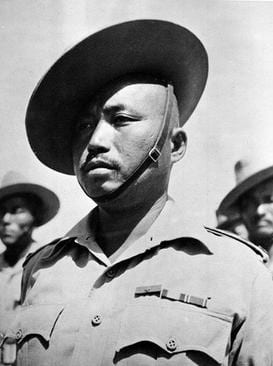
Subedar-Major, British Indian Army
Support & adopt this hero ↓
At Wadi Akarit in Tunisia, a narrow, heavily defended mountain passage stood between the Allied forces and a vital battlefield objective. Under relentless machine-gun fire and exploding grenades, one Gurkha officer led his men into the heart of the enemy defences. His courage and determination helped open the way for an entire division. He was Subedar Lalbahadur Thapa Magar, one of the most distinguished Nepalese recipients of the Victoria Cross.
Born in February 1906 in western Nepal, Lalbahadur Thapa enlisted in the 2nd King Edward VII’s Own Gurkha Rifles, known as the Sirmoor Rifles, on 6 February 1925. Through years of dedicated military service, he rose through the ranks and eventually became a Subedar. During the Second World War, he served with the 1st Battalion, 2nd Gurkha Rifles, as second-in-command of D Company in the 4th Indian Division.
His defining moment came during the night of 5-6 April 1943 at Rass-Ez-Zouai, near Wadi Akarit, Tunisia. Taking command of two sections, Thapa led his Gurkhas through a narrow, steep-sided defile defended by enemy anti-tank guns and machine-gun positions. Despite intense fire and repeated grenade attacks, he pressed forward, personally engaging enemy soldiers with his kukri and revolver. Reaching the crest alongside two riflemen, he captured and secured the vital position, allowing his company to advance and enabling the wider divisional operation to succeed.
For this extraordinary act of gallantry, King George VI approved the award of the Victoria Cross, announced in The London Gazette on 15 June 1943, Supplement No. 36053, page 2719. He became the first Gurkha soldier to receive the Victoria Cross during the Second World War. The citation praised his outstanding leadership, exceptional bravery and complete disregard for his personal safety.
Thapa's distinguished career also earned him the Order of British India, First Class, and the title Sirdar Bahadur. His surviving medal group records his North-West Frontier campaign service, Second World War campaign awards, the King George VI Coronation Medal of 1937, the Indian Independence Medal of 1947, the Queen Elizabeth II Coronation Medal of 1953 and the Nepal Tara Padak. His wartime service is further represented by the 1939-45 Star, Africa Star with 8th Army clasp, Italy Star, Defence Medal and War Medal 1939-45, alongside the India General Service Medal 1936 with its recorded clasps.
After the war, Thapa continued his regimental career, eventually attaining the rank of Subedar-Major and receiving the honorary rank of Captain. He remained closely associated with the Gurkha military tradition until his retirement and later life in Nepal. He died at Paklihawa on 19 October 1968.
Lalbahadur Thapa Magar's legacy extends beyond the Victoria Cross. His actions at Wadi Akarit stand as a remarkable example of Gurkha courage, battlefield leadership and devotion to duty, securing his place among the most celebrated soldiers in the history of the Sirmoor Rifles.
Become the named supporter for this profile and edit the tribute biography and portrait (Owner account required). Proceeds help keep the archive online.
$25 USD / year — annual sponsorship renewal. Keeps the page online and, where enabled, the family anniversary remembrance emails active.