★
Loading archive…
Loading archive…

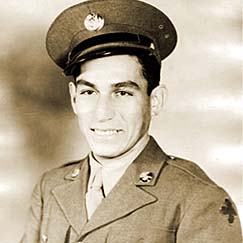
Medal of Honor Recipient and the “Arizona Kid”
Wounded in both the arm and leg and facing an attacking force of approximately 200 German soldiers, Staff Sergeant Manuel V. Mendoza refused to give up the crest of Mount Battaglia. His stand on October 4, 1944, would become one of the extraordinary acts of American combat heroism of World War II. Manuel V. Mendoza was born on June 15, 1922, in Miami, Arizona, and entered the United States Army at Fort MacArthur, California, in November 1942. He served in both World War II and the Korean War, became known as the “Arizona Kid” for his actions in combat, and later attained the rank of Master Sergeant.
Mendoza’s defining wartime action came during the Italian Campaign on October 4, 1944. Serving as a platoon sergeant with Company B, 350th Infantry, 88th Infantry Division, he was defending Mount Battaglia when German forces launched a violent counterattack following a heavy mortar barrage. Already wounded in the arm and leg, Mendoza seized a Thompson submachine gun and moved toward the crest, where he saw approximately 200 enemy soldiers advancing with flamethrowers, machine pistols, rifles and hand grenades.
Mendoza met the attack with an extraordinary succession of weapons. He opened fire with his Thompson, killing ten enemy soldiers before exhausting its ammunition, then picked up a carbine and continued firing. When a German flamethrower operator approached the crest, Mendoza drew his pistol and killed him. With the enemy still advancing, he entered an abandoned machine-gun emplacement, opened fire and then moved forward with the weapon, firing into the attacking force until the gun jammed. Without hesitation, he switched to hand grenades and continued the fight until the German troops finally broke and withdrew.
Even after the counterattack had collapsed, Mendoza continued forward. He moved down the exposed slope, recovered numerous enemy weapons abandoned during the retreat and captured a wounded German soldier before returning to help consolidate the American position. His official Medal of Honor citation credits his stand with the deaths of 30 German soldiers and the successful defense of Mount Battaglia. What had begun as a determined enemy assault against the hill had been shattered in large part by the actions of one wounded American platoon sergeant who refused to surrender his position.
Mendoza’s heroism at Mount Battaglia was originally recognized with the Distinguished Service Cross, the United States Army’s second-highest decoration for valor. Nearly seven decades later, his case became part of a congressionally mandated review intended to determine whether veterans of World War II, the Korean War and the Vietnam War had been denied appropriate recognition because of prejudice or discrimination. The Army reviewed hundreds of Distinguished Service Cross cases, and Mendoza was among the soldiers whose actions were determined to merit the nation’s highest military decoration. His Distinguished Service Cross was subsequently upgraded to the Medal of Honor as part of the historic Valor 24 recognition.
Mendoza continued his military service beyond World War II and later served during the Korean War, giving him a combat career that spanned two of the defining American conflicts of the twentieth century. His Army record reflects extensive recognition for combat, campaign and unit service across both wars. The individual medals, campaign awards, foreign honours and authorized ribbon devices associated with his career are documented separately in his complete honours record so that each can be presented according to its verified historical entitlement.
Following his Army career, Mendoza returned to civilian life and worked as a foreman at what the United States Army describes as one of the largest nuclear plants in the country. He died in 2001 at the age of 79. For decades, the extraordinary stand he had made on Mount Battaglia remained officially recognized by the Distinguished Service Cross. Mendoza did not live to see that decoration elevated to the Medal of Honor, but the record of what he had done on that Italian hillside endured.
On March 18, 2014, almost seventy years after the battle, President Barack Obama posthumously awarded Manuel V. Mendoza the Medal of Honor during the historic Valor 24 ceremony at the White House. His widow, Alice Mendoza, accepted the medal on behalf of her husband as his citation was read in the East Room. The award formally recognized what Mendoza’s actions on Mount Battaglia had demonstrated decades earlier: extraordinary gallantry, selflessness and determination in the face of overwhelming enemy strength, actions that helped save the American position and secured his place among the most highly decorated soldiers of the Second World War.
Become the named supporter for this profile and edit the tribute biography and portrait (Owner account required). Proceeds help keep the archive online.
$25 USD / year — annual sponsorship renewal. Keeps the page online and, where enabled, the family anniversary remembrance emails active.