★
Loading archive…
Loading archive…

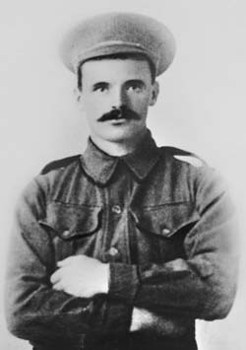
He crossed shell-swept ground to take the wounded to safety.
Martin O'Meara was born near Lorrha, County Tipperary, Ireland, on 6 November 1885. He worked as a labourer and tree feller before emigrating to Australia, where he found work in the timber industry. He enlisted in the Australian Imperial Force at Blackboy Hill, Western Australia, in August 1915.
After sailing to Egypt that December, he joined the 16th Battalion in March 1916 and reached France in June. Between 9 and 12 August, during the fighting near Pozières and Mouquet Farm, he repeatedly went into no man's land to bring back wounded officers and men. The ground was exposed to artillery and machine-gun fire, and each rescue required him to cross it again.
He also volunteered to carry ammunition and grenades through a heavy barrage to men in a threatened part of the line. His Victoria Cross citation recognized the lives saved through those repeated journeys and the example he gave throughout four days of fighting. Wounded in the abdomen, he was evacuated to Britain.
O'Meara returned to France and served again in 1917 and 1918, sustaining further wounds. King George V presented his Victoria Cross in July 1917. He later became a sergeant and was sent back to Australia shortly before the end of the war.
Soon after his return he suffered a severe mental breakdown. He was treated in military hospitals and then in institutions in Western Australia, spending much of the remainder of his life at Claremont and Lemnos. He did not recover sufficiently to resume civilian work. He died in Perth on 20 December 1935 and received a military funeral before burial at Karrakatta Cemetery. His medals were preserved by the Army Museum of Western Australia and later lent to Ireland for public commemoration of his service.
Official Victoria Cross citation
For most conspicuous bravery. During four days of very heavy fighting he repeatedly went out and brought in wounded officers and men from “No Man’s Land” under intense artillery and machine-gun fire. He also volunteered and carried up ammunition and bombs through a heavy barrage to a portion of the trenches, which was being heavily shelled at the time. He showed throughout an utter contempt of danger, and undoubtedly saved many lives.
Supplement to The London Gazette of 8 September 1916. 9 September 1916, Numb. 29740, p. 8871
Become the named supporter for this profile and edit the tribute biography and portrait (Owner account required). Proceeds help keep the archive online.
$25 USD / year — annual sponsorship renewal. Keeps the page online and, where enabled, the family anniversary remembrance emails active.