★
Loading archive…
Loading archive…
He fought on despite his wounds to protect a fallen officer.
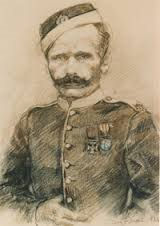
Michael Murphy was born on 5 September 1831 in Cahir, County Tipperary, Ireland. A blacksmith by trade, he enlisted in the British Army on 27 August 1855, initially joining the 17th Lancers. In October 1856, he transferred to the 2nd Battalion, Military Train, which reached India in August 1857 during the Indian Rebellion.
Murphy served during the Lucknow operations before joining the campaign against Kunwar Singh's forces near Azamgarh.
On 15 April 1858, during the pursuit of the retreating enemy, Lieutenant Hamilton of the 3rd Sikh Cavalry was unhorsed, wounded and surrounded. Murphy charged into the fighting, attacked the assailants and remained beside the injured officer despite suffering severe wounds himself. Private Samuel Morley also fought to defend Hamilton and later received the Victoria Cross for his part in the rescue. Although Hamilton was saved from immediate death on the battlefield, he died of his injuries the following day.
Murphy's gallantry was recognised with the Victoria Cross, announced in the London Gazette on 27 May 1859. Queen Victoria presented him with the decoration at Windsor Castle on 4 January 1860.
Following his recovery, Murphy continued his military career. He became a Farrier Sergeant in February 1860 and later served in Canada. His subsequent appointments included service with the Army Service Corps and the 7th Hussars, with Farrier-Major recorded during the latter period. The Victoria Cross and George Cross Association identifies his final rank as Farrier Sergeant.
In March 1872, Murphy was convicted of stealing military forage and sentenced to nine months of hard labour. His Victoria Cross was formally forfeited. The physical medal later resurfaced, but the forfeiture should not be confused with an official reinstatement.
Murphy returned to military service after imprisonment but suffered declining health. He was medically discharged on 1 February 1875 and subsequently worked as a blacksmith and labourer.
During his later years, fellow Victoria Cross recipient Sir Henry Havelock-Allan assisted him and helped obtain a government pension. Murphy died in Darlington on 4 April 1893 and was buried in North Road Municipal Cemetery, where Havelock-Allan arranged a memorial.
Become the named supporter for this profile and edit the tribute biography and portrait (Owner account required). Proceeds help keep the archive online.
$25 USD / year — annual sponsorship renewal. Keeps the page online and, where enabled, the family anniversary remembrance emails active.