★
Loading archive…
Loading archive…
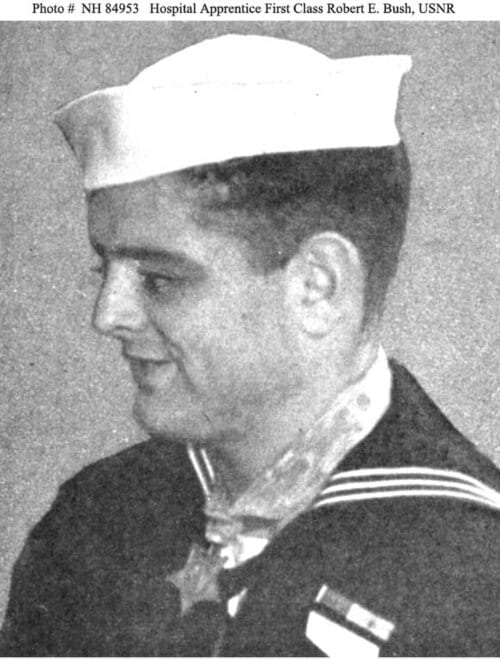
Hospital Apprentice First Class, U.S. Navy
Support & adopt this hero ↓Treating a wounded officer during an Okinawa counterattack
Robert Eugene Bush earned the Medal of Honor as a Navy medical corpsman on Okinawa on 2 May 1945. Moving between casualties under artillery, mortar and machine-gun fire, he reached a wounded Marine officer on a ridge. When Japanese troops counterattacked, Bush continued administering plasma with one hand while firing a pistol and then a carbine with the other. Despite severe wounds and the loss of an eye, he protected his patient and completed treatment. He refused care for himself until the officer was evacuated, then collapsed while trying to reach an aid station.
Medal of Honor citation
For conspicuous gallantry and intrepidity at the risk of life above and beyond the call of duty while serving as medical corpsman with a rifle company, in action against enemy Japanese forces on Okinawa Jima, Ryukyu Islands, 2 May 1945. Fearlessly braving the fury of artillery, mortar, and machine-gun fire from strongly entrenched hostile positions, Bush constantly and unhesitatingly moved from one casualty to another to attend the wounded falling under the enemy's murderous barrages. As the attack passed over a ridge top, Bush was advancing to administer blood plasma to a marine officer lying wounded on the skyline when the Japanese launched a savage counterattack. In this perilously exposed position, he resolutely maintained the flow of lifegiving plasma. With the bottle held high in one hand, Bush drew his pistol with the other and fired into the enemy ranks until his ammunition was expended. Quickly seizing a discarded carbine, he trained his fire on the Japanese charging point-blank over the hill, accounting for six of the enemy despite his own serious wounds and the loss of one eye suffered during his desperate battle in defense of the helpless man. With the hostile force finally routed, he calmly disregarded his own critical condition to complete his mission, valiantly refusing medical treatment for himself until his officer patient had been evacuated, and collapsing only after attempting to walk to the battle aid station. His daring initiative, great personal valor, and heroic spirit of self-sacrifice in service of others reflect great credit upon Bush and enhance the finest traditions of the U.S. Naval Service.
Become the named supporter for this profile and edit the tribute biography and portrait (Owner account required). Proceeds help keep the archive online.
$25 USD / year — annual sponsorship renewal. Keeps the page online and, where enabled, the family anniversary remembrance emails active.