★
Loading archive…
Loading archive…
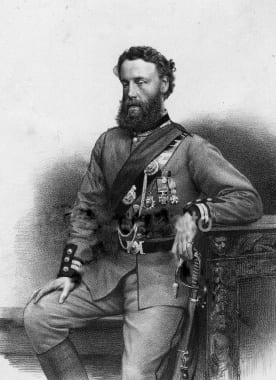
Brigadier General, British Army
Support & adopt this hero ↓
When the British line faltered under fire at the Battle of the Alma, one young officer refused to abandon the Queen's Colours. Robert James Loyd-Lindsay stood firm, rallied his men and helped restore order in the midst of battle. Less than two months later, at Inkerman, he led a small party against a superior force of Russian troops, personally running one of the enemy through with his sword. These acts of courage in the Crimean War earned him the Victoria Cross and began a remarkable life of military service, public leadership and humanitarian achievement.
Robert James Loyd-Lindsay, 1st Baron Wantage, was born in 1832 in London into a distinguished military family. The son of Lieutenant-General James Lindsay, he was educated at Eton College before receiving his commission in the Scots Fusilier Guards in December 1850. In February 1854, his regiment sailed for the Crimea, where British forces were engaged in a demanding campaign against the Russian Empire. At the Battle of the Alma on 20 September 1854, Lindsay carried the Queen's Colours as the regiment became disordered following a mistaken order to retire. Refusing to yield ground, he helped rally the soldiers and restore the formation. At the Battle of Inkerman on 5 November 1854, he again distinguished himself by leading a small group of men in a determined charge against Russian troops, driving them back at a critical moment. His gallantry at both engagements earned him a double recommendation for the newly instituted Victoria Cross. Gazetted on 24 February 1857, the decoration was presented to him by Queen Victoria at the historic Hyde Park investiture later that year. He also received foreign decorations for his Crimean service, including the French Legion of Honour and the Ottoman Order of the Medjidie.
Following his return from the Crimea, Loyd-Lindsay continued his military career, serving as an aide-de-camp to General Sir James Simpson and subsequently as adjutant of his regiment. He was promoted to brevet major and became a musketry instructor at the newly established school at Hythe. In 1858, he married Harriet Sarah Jones-Loyd, the only surviving child and heiress of the wealthy banker Samuel Jones-Loyd, Baron Overstone. Following their marriage, Robert adopted the additional surname Loyd, becoming Robert Loyd-Lindsay. He retired from the regular Army in 1859 with the rank of lieutenant-colonel, but his military involvement was far from over. He became a leading figure in Britain's Volunteer movement, helping to raise and organize the Berkshire Volunteer forces. He served as Colonel of the Royal Berkshire Volunteers, commanded the Honourable Artillery Company from 1866 to 1881, and later became Brigadier-General of the Home Counties Brigade. His dedication to volunteer military service earned him the Volunteer Officers' Decoration, while his contribution to the organization of Britain's auxiliary forces was recognized with appointment as a Knight Commander of the Order of the Bath in 1881.
Beyond his military achievements, Loyd-Lindsay became one of the most influential humanitarian figures of Victorian Britain. When the Franco-Prussian War broke out in 1870, reports of wounded soldiers and the suffering of civilians inspired him to take action. A letter he published in The Times helped lead to the establishment of the National Society for Aid to the Sick and Wounded in War, the organization that later developed into the British Red Cross Society. As its founding chairman, he helped organize medical relief, coordinate assistance to wounded combatants and bring humanitarian aid to the battlefields of Europe. He personally travelled to France, visited the Prussian headquarters at Versailles and entered besieged Paris to witness the conditions faced by those affected by the conflict. His leadership helped secure the patronage of Queen Victoria and establish the foundations of a lasting British humanitarian institution. His commitment to the Red Cross remained strong throughout his life. Even in 1900, despite declining health, he wished to travel to South Africa to assist the organization's relief operations during the Boer War.
Loyd-Lindsay also made a substantial contribution to British political and public life. Elected Conservative Member of Parliament for Berkshire in 1865, he represented the constituency until 1885. From 1877 to 1880, he served as Financial Secretary to the War Office, where his military experience informed his work on defence administration. In 1885, he was elevated to the peerage as Baron Wantage of Lockinge and became Lord Lieutenant of Berkshire. He subsequently chaired a government committee examining conditions of service in the British Army, whose recommendations helped improve the circumstances of ordinary soldiers. Away from Westminster, he devoted considerable attention to the Lockinge estate and the development of the surrounding communities. Together with his wife, he supported education, agriculture, charitable causes and cultural institutions, including Reading University College. He became widely respected as a benefactor to Wantage and the surrounding county, combining public responsibility with a strong commitment to local improvement.
Robert James Loyd-Lindsay, 1st Baron Wantage, died at Lockinge on 10 June 1901. His legacy extends far beyond the Victoria Cross he earned in the Crimea. He was a courageous officer who stood firm with his regiment's Colours, a pioneer of Britain's Volunteer forces, a parliamentary leader and one of the founding figures of the British Red Cross. His life connected the battlefield with the hospital, military duty with public service, and personal courage with compassion for others. Remembered as Lord Wantage, he remains an important figure in the history of the Victoria Cross, the British Army and the development of organized humanitarian relief in Britain.
Become the named supporter for this profile and edit the tribute biography and portrait (Owner account required). Proceeds help keep the archive online.
$25 USD / year — annual sponsorship renewal. Keeps the page online and, where enabled, the family anniversary remembrance emails active.