★
Loading archive…
Loading archive…

What does a soldier do when his company has withdrawn, his hand has been shot, his head has been struck by shrapnel and his weapon has been knocked from his grasp? Second Lieutenant Robert Sheldon Scott remained where he was and continued fighting. His lone stand near Munda Airfield on 29 July 1943 stopped a Japanese counterattack, inspired exhausted American troops to renew their advance and earned him the Medal of Honor. Yet that extraordinary moment was only one chapter in a military career that continued through the Second World War, the Korean War and the opening years of the Vietnam era.
Robert Sheldon Scott was born in Washington, D.C., on 30 November 1913. His family later moved to New Mexico, where he attended Albuquerque High School and competed in football and basketball. Scott continued playing basketball at the University of New Mexico, graduating in 1937 with a bachelor’s degree in English and a minor in French. He later attended the University of Kansas School of Business Administration before entering the United States Army during the Second World War. After completing Officer Candidate School, he was commissioned as a second lieutenant in September 1942.
Scott was assigned to Company C, 1st Battalion, 172nd Infantry Regiment, 43rd Infantry Division. By the summer of 1943, the division was fighting through the difficult New Georgia Campaign in the Solomon Islands. American forces were attempting to capture Munda Airfield, a strategically important Japanese base protected by fortified positions, dense jungle and determined defenders. Scott commanded the leading platoon during an attack against a hilltop salient controlling the approach to the airfield.
On 29 July 1943, after nearly a month of bitter fighting, Scott advanced across exposed ground under intense rifle and machine-gun fire. He had moved ahead of his platoon and reached a point approximately 75 yards from the enemy when Japanese troops launched a powerful counterattack. The rest of his company withdrew, leaving Scott isolated with only the remains of a shattered tree stump for protection. Would he retreat, or could one wounded officer hold the hill long enough to prevent the enemy from reclaiming it?
Scott chose to stand his ground. He fired his carbine and threw grenades into the advancing Japanese troops, temporarily halting their attack. During the fighting, he suffered a bullet wound to his left hand and a painful shrapnel wound to his head. His carbine was then shot from his grasp. Instead of withdrawing, Scott obtained more grenades and continued throwing them with devastating accuracy while enemy bullets and explosives struck around his position. His resistance finally broke the counterattack and forced the surviving enemy soldiers to withdraw.
The effect of Scott’s stand reached far beyond the position he defended. Encouraged by the sight of their lieutenant refusing to yield, the American troops renewed their attack and swept across the plateau. They captured the contested hill, and four days later United States forces seized Munda Airfield. Scott’s official Medal of Honor citation praised his conspicuous gallantry, personal courage and willingness to risk his life above and beyond the call of duty. The Medal of Honor was presented to him at Aitape, New Guinea, on 14 October 1944 by Major General Leonard F. Wing.
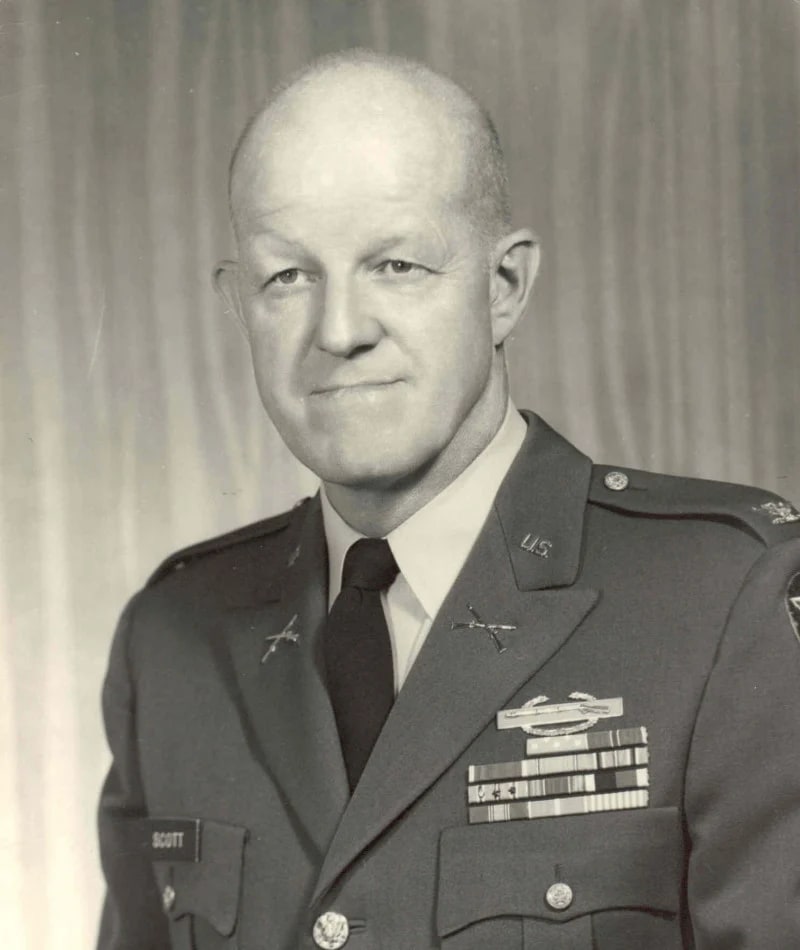
The Medal of Honor became the best-known recognition of Scott’s service, but it did not represent the full extent of his military career. His retirement-era ribbon group reflected his wounds, combat service in the Pacific, participation in the liberation of the Philippines, occupation service and later Korean War duty. The group included the Bronze Star Medal, Purple Heart, American Campaign Medal, Asiatic-Pacific Campaign Medal, World War II Victory Medal, Army of Occupation Medal, National Defense Service Medal, Korean Service Medal, Philippine Liberation Ribbon and United Nations Service Medal for Korea. Some ribbon devices remain supported primarily by his retirement portrait rather than surviving award orders, so they should be described as historically reconstructed unless his complete personnel file becomes available.
After the Second World War, Scott was released from active duty in 1945 but returned to the Army in 1947. He served during the Korean War, worked in plans and training assignments, acted as an adviser in Korea and commanded a battalion in the 7th Infantry Division. His postings took him and his family throughout the United States and to assignments in Germany, Japan, Korea and the Philippines. He completed his career as Professor of Military Science and head of Army ROTC at Centenary College in Shreveport, Louisiana, retiring as a colonel in 1966.
Scott rarely sought attention for what he had done near Munda. His son later recalled that he disliked being treated as a hero and regarded his actions as the performance of a duty that had to be completed. In 1997, New Mexico Governor Gary Johnson proclaimed Scott’s birthday, 30 November, as Colonel Robert Scott Day. During the congressional recognition of that event, Scott explained that his actions had grown partly from his belief that an officer should possess the courage to attempt anything he was authorized to order a soldier to do.
Colonel Robert Sheldon Scott died in Santa Fe, New Mexico, on 5 February 1999 at the age of 85. He was buried at Santa Fe National Cemetery, where the Department of Veterans Affairs records his service in the Second World War and Korea, his final rank of colonel and his receipt of the Medal of Honor and Purple Heart.
Robert Sheldon Scott’s legacy is not defined only by the medal he received. It rests upon the decision he made when withdrawal would have been understandable and survival seemed uncertain. Alone, wounded and almost without weapons, he refused to surrender a vital position. His stand near Munda Airfield demonstrated the leadership he believed every officer owed to the soldiers under his command, and it remains one of the most compelling acts of individual courage from the Pacific War.
Become the named supporter for this profile and edit the tribute biography and portrait (Owner account required). Proceeds help keep the archive online.
$25 USD / year — annual sponsorship renewal. Keeps the page online and, where enabled, the family anniversary remembrance emails active.