Loading archive…
Loading archive…

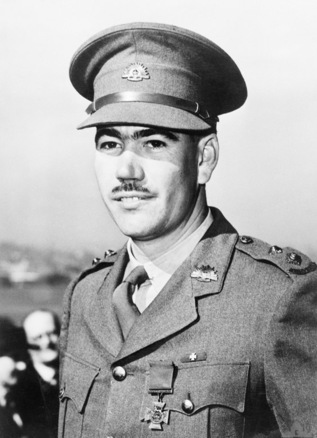
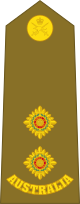
Lieutenant, Australian Army
Support & adopt this hero ↓Arthur Roden Cutler, designated on the Australian military roll under service number NX12378, was born in the Sydney harbour suburb of Manly on 24 May 1916. Educated at Manly Public School and Sydney Boys High School, he balanced employment with an oil firm by pursuing night courses in economics at the University of Sydney, where he achieved varsity distinction as a swimmer alongside his pursuits in rifle shooting and water polo. His citizen soldiering began in March 1936 with the Sydney University Regiment, where he earned a militia commission as a lieutenant on 10 November 1939. Volunteering for overseas combat with the Second Australian Imperial Force upon the expansion of the war in May 1940, Cutler was posted to the 2/5th Field Regiment within the 7th Australian Division Artillery. After sailing for the Middle East in October 1940 and completing desert training in Palestine and Egypt, he accompanied the Allied advance against Vichy French forces in the Syria-Lebanon campaign in June 1941, operating in the exposed forward echelon as an artillery observation officer.
During nineteen days of fighting across the rugged hill positions surrounding Merdjayoun and Damour, his operational audacity and repeated refusal to abandon isolated forward positions proved instrumental in directing Allied defensive fires, breaking enemy tank sallies, and establishing vital fire registers under direct hostile barrage. Promulgated in the Second Supplement to The London Gazette of 25 November 1941 (published 28 November 1941, issue number 35360, page 6825), the exact, verbatim official citation for the Victoria Cross records his actions:
"War Office, 28th November, 1941.
The KING has been graciously pleased to approve the award of the VICTORIA CROSS to the under-mentioned: —
Lieutenant Arthur Roden Cutler (NX.12378), Australian Military Forces.
For most conspicuous and sustained gallantry during the Syrian Campaign and for outstanding bravery during the bitter fighting at Merdjayoun when this artillery officer became a byword amongst forward troops with which he worked.
At Merdjayoun on 19th June, 1941, our infantry attack was checked after suffering heavy casualties from an enemy counter-attack with tanks. Enemy machine gun fire swept the ground, but Lieutenant Cutler with another artillery officer and a small party pushed on ahead of the infantry and established an outpost in a house. The telephone line was cut and he went out and mended this line under machine gun fire and returned to the house, from which enemy posts and batteries were successfully engaged. The enemy then attacked this outpost with infantry and tanks, killing the Bren gunner and mortally wounding other officers. Lieutenant Cutler and another manned the anti-tank rifle and Bren gun and fought back, driving the enemy infantry away. The tanks continued the attack, but under constant fire from the anti-tank rifle and Bren gun eventually withdrew. Lieutenant Cutler than personally supervised the evacuation of the wounded members of his party. Undaunted he pressed for a further advance. He had been ordered to establish an outpost from which he could register the only road by which the enemy transport could enter the town. With a small party of volunteers he pressed on until finally with one other he succeeded in establishing an outpost right in the town, which was occupied by the Foreign Legion, despite enemy machine gun fire which prevented our infantry from advancing. At this time Lieutenant Cutler knew the enemy were massing on his left for a counter-attack and that he was in danger of being cut off. Nevertheless he carried out his task of registering the battery on the road and engaging enemy posts. The enemy counter-attacked with infantry and tanks and he was cut off. He was forced to go to ground, but after dark succeeded in making his way through enemy lines. His work in registering the only road by which enemy transport could enter the town was of vital importance and a big factor in the enemy’s subsequent defeat.
On the night of 23rd-24th June he was in charge of a 25-pounder sent forward into our forward defended localities to silence an enemy anti-tank gun and post, which had held up our attack. This he did and next morning the capture of Merdjayoun was completed. Later at Damour on 6th July, when our forward infantry were pinned to the ground by heavy hostile machine gun fire Lieutenant Cutler, regardless of all danger, went to bring a line to his outpost when he was seriously wounded. Twenty-six hours elapsed before it was possible to rescue this officer, whose wounds by this time had become septic necessitating the amputation of his leg. Throughout the Campaign this officer’s courage was unparalleled and his work was a big factor in the recapture of Merdjayoun."
Invalided home to Sydney, he received his Victoria Cross from the Governor-General, Lord Gowrie, at Admiralty House on 11 June 1942, before receiving an honourable medical discharge from the military on 23 December 1942. He transferred his energies into public administration and external representation, serving as Australian High Commissioner to New Zealand, Ceylon, and Pakistan, Head of the Australian Legation in Egypt through the 1956 Suez crisis, Consul-General in New York, and Ambassador to the Netherlands. Appointed the thirty-second Governor of New South Wales on 20 January 1966, Sir Roden discharged viceregal responsibilities for an unprecedented fifteen-year tenure through four premiers until stepping down on 19 January 1981, remaining an active community figure until his death in Sydney on 21 February 2002.
Become the named supporter for this profile and edit the tribute biography and portrait (Owner account required). Proceeds help keep the archive online.
$25 USD / year — annual sponsorship renewal. Keeps the page online and, where enabled, the family anniversary remembrance emails active.