★
Loading archive…
Loading archive…
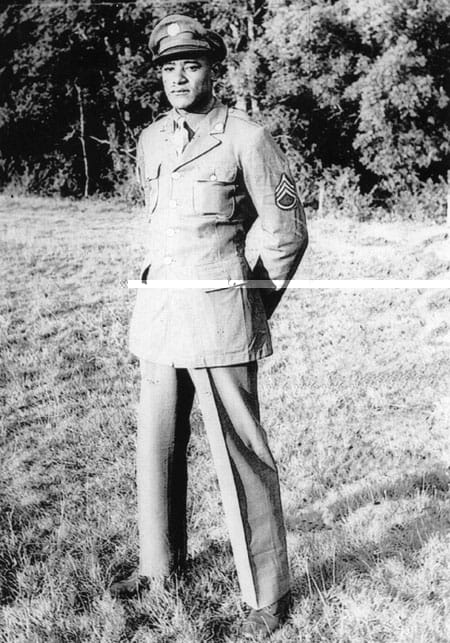
Staff sergeant, U.S. Army
Support & adopt this hero ↓
Medal of Honor Recipient and Hero of the 761st Tank Battalion
Staff Sergeant Ruben Rivers had already earned the Silver Star when a German mine tore open his leg in France. He was offered morphine, medical treatment, and evacuation. He refused all three. For the next three days, Rivers remained in command of a tank and continued fighting until enemy fire killed him on November 19, 1944. More than fifty years would pass before the United States awarded him the Medal of Honor.
Ruben Rivers was born on October 30, 1918, in Tecumseh, Oklahoma, and grew up in nearby Hotulka with his 11 brothers and sisters, working on the family farm. After graduating from high school in 1938, he worked for a local railroad and later moved to Oklahoma City. Rivers registered for the draft on October 16, 1940, and entered the United States Army in January 1942.
He was assigned to what became the 761st Tank Battalion, one of the Army's segregated Black armored units. The battalion was officially activated at Camp Claiborne, Louisiana, on April 1, 1942. Rivers served in Company A, or Able Company, and proved himself during the unit's long training period in Louisiana and Texas. He eventually rose to Staff Sergeant and served as a tank platoon sergeant.
The men of the 761st trained for years while facing both the demands of armored warfare and the discrimination of a segregated Army. By 1944, Rivers and his fellow tankers were operating M4 Sherman medium tanks and were finally alerted for overseas service. On August 27, 1944, the battalion sailed from New York aboard Esperance Bay. After preparing in Britain and receiving newer Sherman tanks, the 761st landed at Omaha Beach in France on October 10, 1944. The battalion then moved rapidly across France to join Lieutenant General George S. Patton's Third Army.
Rivers did not have to wait long to prove himself in combat.
On November 8, 1944, Able Company was supporting the 104th Infantry Regiment during an attack near Vic-sur-Seille, France. A German roadblock blocked the American advance along a narrow road while enemy small-arms fire covered the obstacle. Rivers was commanding the lead tank.
Instead of waiting under fire, he climbed out.
The citation for Rivers's Silver Star records that, with what it described as utter disregard for his personal safety, he dismounted in the face of directed enemy fire, attached a cable to the roadblock, and used his tank to pull the obstruction clear. His action reopened the route, prevented a serious delay, and helped make possible the successful assault and capture of the town. The National Museum of the United States Army identifies it as the first Silver Star earned by a member of the 761st Tank Battalion.
Eight days later came the action that would ultimately make Ruben Rivers a Medal of Honor recipient.
On November 16, 1944, Rivers and Able Company were advancing toward Guébling, France, when his Sherman struck a mine at a railroad crossing. The explosion inflicted a devastating wound, slashing his leg to the bone. According to his Medal of Honor citation, Rivers declined morphine, refused evacuation, took command of another tank, and continued with his company. His combat wound also resulted in the Purple Heart.
His decision was extraordinary because the battle was not ending. It was intensifying.
On November 17, Rivers advanced with his company into Guébling. Despite his worsening injury, he continued directing tank fire against German positions. Again and again, he refused evacuation. By the morning of November 19, he had remained in combat for several days with a wound serious enough to have removed him from the battlefield immediately.
That morning, Able Company moved toward Bourgaltroff and encountered heavy German resistance, including anti-tank positions that brought the advance to a halt. Captain David J. Williams ordered his tanks to withdraw and seek cover.
Rivers had located the enemy.
His Medal of Honor citation preserves his reply: "I see 'em. We'll fight 'em!"
Rivers and another American tank engaged the German positions while the rest of Able Company withdrew. His decision placed his tank directly against the enemy fire, but it also helped cover his comrades as they moved back. During the engagement, Rivers's Sherman was struck. Rivers was killed and the other members of his crew were wounded. He was 26 years old.
The concluding words of his Medal of Honor citation captured what his fellow soldiers had witnessed. It credited Rivers's fighting spirit and daring leadership as an inspiration to his unit and stated that his actions exemplified the highest traditions of military service.
Captain Williams believed Rivers deserved the Medal of Honor. Modern Army and National Park Service histories state that on November 23, 1944, Williams submitted paperwork seeking the award. The recognition did not follow. Rivers had already received the Silver Star and Purple Heart, but the Army did not award him its highest decoration during World War II.
His case belonged to a much larger failure. More than one million Black Americans served in the armed forces during World War II, yet no Black serviceman received the Medal of Honor for World War II service at the time. Decades later, the Army undertook a review of the awards process and examined whether racial discrimination had prevented deserving Black soldiers from receiving the nation's highest military decoration. The resulting historical review led to the reconsideration of Rivers and other World War II soldiers.
On January 13, 1997, President William J. Clinton held a White House ceremony recognizing seven African American World War II soldiers with the Medal of Honor. Rivers was one of six honored posthumously. His sister Grace accepted the Medal of Honor on his behalf, while Captain Williams lived to see the soldier he had commanded finally receive the recognition that had eluded him for more than half a century.
President Clinton recalled that Rivers had already earned the Silver Star before being terribly wounded, then took another tank and continued fighting. The President placed Rivers among the "bravest of the brave" and used the ceremony to acknowledge that Black soldiers who had demonstrated extraordinary valor during World War II had not received equal recognition.
Rivers rests today at the Lorraine American Cemetery and Memorial near Saint-Avold, France, in Plot C, Row 5, Grave 53. The cemetery is the largest American World War II cemetery in Europe and contains the graves of more than 10,000 American war dead.
The story of Ruben Rivers is also inseparable from the 761st Tank Battalion. The Black Panthers went on to fight through the Rhineland, Ardennes-Alsace, and Central Europe campaigns. In 1978, President Jimmy Carter awarded the battalion the Presidential Unit Citation for its distinguished service from October 31, 1944, through May 6, 1945. Rivers fought and died during the opening weeks of that cited period.
Ruben Rivers spent only a matter of weeks in combat in Europe, but those weeks established an extraordinary record of courage. At Vic-sur-Seille, he climbed from the protection of his tank under enemy fire and cleared the road for the troops behind him. At Guébling, he suffered a devastating wound and chose to remain with his company. At Bourgaltroff, with withdrawal ordered and German anti-tank weapons ahead, he stayed in the fight so others could escape.
His Silver Star recognized his courage. His Purple Heart marked the blood he shed in combat. His Medal of Honor finally recognized the full measure of what he did. Ruben Rivers did not live to see that final honor, but his actions with the 761st Tank Battalion made his place in American military history impossible to erase.
Become the named supporter for this profile and edit the tribute biography and portrait (Owner account required). Proceeds help keep the archive online.
$25 USD / year — annual sponsorship renewal. Keeps the page online and, where enabled, the family anniversary remembrance emails active.