★
Loading archive…
Loading archive…
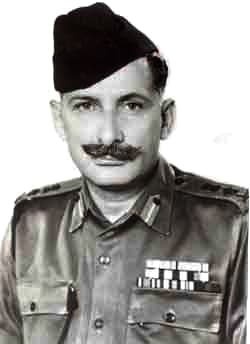
Field Marshal, Indian Army
Support & adopt this hero ↓
Few military commanders have changed the course of a nation's history as decisively as Field Marshal Sam Manekshaw. Revered as "Sam Bahadur," he led India to its greatest military victory in 1971, oversaw the birth of Bangladesh, and became the first officer of the Indian Army to attain the rank of Field Marshal. His remarkable career, however, began decades earlier on the battlefields of Burma, where his courage under fire earned the Military Cross and marked him as one of India's outstanding young officers.
Born on 3 April 1914 in Amritsar, Punjab, Sam Hormusji Framji Jamshedji Manekshaw was the fifth of six children in a Parsi family whose parents had emigrated from Gujarat. After completing his education, he was selected as one of the first cadets to attend the newly established Indian Military Academy at Dehradun. Commissioned into the British Indian Army in 1934, he began his military career with the 4th Battalion, 12th Frontier Force Regiment, laying the foundations for a lifetime of distinguished service.
During the Second World War, Manekshaw served in the Burma campaign against the Japanese. In February 1942, during fierce fighting near Pagoda Hill, he led his company in a determined assault despite intense enemy fire. Struck by multiple machine-gun bullets and left critically wounded, he refused to abandon his command until the objective had been secured. His courage and leadership earned him the Military Cross, one of the British Empire's highest awards for gallantry available to officers, establishing a reputation for calmness and determination that would follow him throughout his career.
Following the war, Manekshaw played an important role in the transition from the British Indian Army to the armed forces of an independent India. He served in senior operational and staff appointments during the difficult years following Partition and steadily rose through the ranks as the Indian Army expanded and modernised. Respected for his professionalism, honesty and concern for the welfare of his soldiers, he became one of the Army's most capable and influential commanders.
In 1969, Manekshaw was appointed Chief of the Army Staff. His greatest challenge came two years later as millions of refugees fled from East Pakistan into India. While political pressure mounted for immediate military intervention, Manekshaw insisted that the Army required time to prepare properly. His careful planning ensured that when India entered the conflict in December 1971, the armed forces were fully equipped and strategically positioned for success.
The resulting campaign was one of the most decisive military victories of the twentieth century. Under Manekshaw's leadership, the Indian Army, working alongside the Indian Air Force, Indian Navy and the Mukti Bahini, rapidly overwhelmed Pakistani forces in East Pakistan. On 16 December 1971, more than 90,000 Pakistani troops surrendered at Dhaka, bringing the war to a swift conclusion and leading directly to the creation of the independent nation of Bangladesh. The victory transformed the strategic balance of South Asia and remains one of the Indian Army's greatest achievements.
For his exceptional service to the nation, Manekshaw was appointed Padma Bhushan in 1968, followed by the Padma Vibhushan in 1972, India's second-highest civilian honour. His distinguished military career was further recognised through numerous campaign and service medals earned during more than four decades in uniform, reflecting service from the Second World War through the defining conflicts of independent India.
On 1 January 1973, Sam Manekshaw became the first officer of the Indian Army to be promoted to the five-star rank of Field Marshal. The honour recognised not only his leadership during the 1971 war but also his lifelong contribution to the development of India's professional armed forces. Although officially retired, he remained one of the country's most respected military figures and continued to inspire generations of officers through his wit, integrity and unwavering commitment to military professionalism.
Field Marshal Sam Manekshaw died on 27 June 2008 at the age of 94. His legacy extends far beyond his battlefield successes. Remembered as an exceptional strategist, an inspirational leader and a commander who always placed the welfare of his soldiers first, he helped shape the modern Indian Army and demonstrated the decisive impact of sound military leadership. More than half a century after the Bangladesh Liberation War, "Sam Bahadur" remains one of the most admired and influential soldiers in India's history.
Field Marshal Sam Manekshaw occupies a unique place in military history as the architect of India's victory in the 1971 Indo-Pakistani War and the nation's first Field Marshal. His leadership brought about one of the largest military surrenders since the Second World War and directly contributed to the creation of Bangladesh. Decorated for gallantry with the Military Cross during the Burma campaign and later honoured with the Padma Bhushan and Padma Vibhushan, Manekshaw's career spanned the transformation of the British Indian Army into the modern Indian Army. His professionalism, strategic vision and devotion to his soldiers continue to make him one of the most respected military leaders of the twentieth century.