★
Loading archive…
Loading archive…
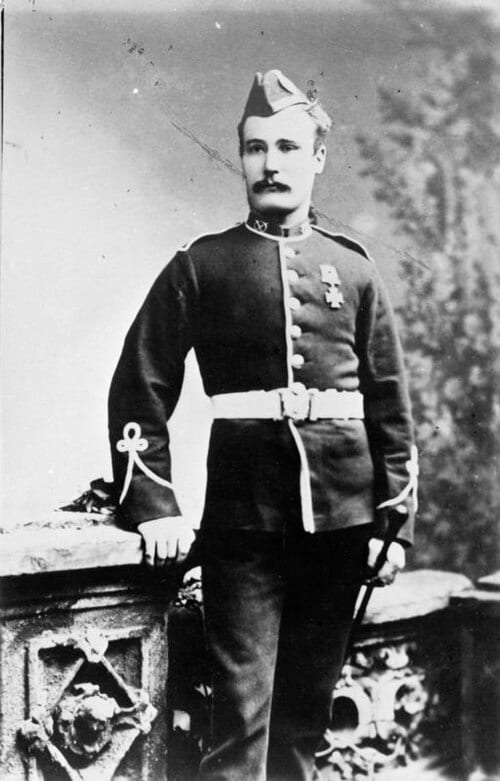
Private (or equivalent), British Army
Support & adopt this hero ↓
The Soldier Who Turned Back Into the River at Isandlwana
When thousands of Zulu warriors swept across the British camp at Isandlwana, survival became the only thought in the minds of the escaping soldiers. Yet, as Private Samuel Wassall reached the dangerous waters of the Buffalo River, he made a decision that could have cost him his life. Instead of continuing towards safety, he turned back to rescue a fellow soldier who was being swept away by the powerful current. With Zulu warriors closing in and bullets striking around him, Wassall risked everything to save another man's life. That extraordinary act of courage would earn him the Victoria Cross, Britain's highest award for gallantry in the face of the enemy.
Born on 28 July 1856 in the Deritend district of Birmingham, England, Samuel Wassall was the son of Thomas Wassall, a wire worker, and Elizabeth Wassall. Before entering military service, he worked as an apprentice dyer. Seeking a different future, he enlisted in the British Army at Dudley on 28 November 1874, joining the 80th Regiment of Foot, later known as the South Staffordshire Regiment, as Private No. 427.
His early military career took him far beyond Britain. In November 1875, Wassall was among three companies of the 80th Regiment sent as reinforcements to Singapore during the crisis in Perak, Malaya, following the murder of the province's British Resident. His service in this expedition earned him the India General Service Medal with the Perak clasp. Following this deployment, his regiment continued its overseas service before Wassall eventually arrived in South Africa.
In 1878, Wassall volunteered for mounted infantry service and became attached to Carrington's Mounted Infantry, also known as Carrington's Horse. This assignment placed him among the mounted troops operating across the difficult terrain of southern Africa. As tensions with the Zulu Kingdom escalated, British forces prepared for an invasion of Zululand under Lieutenant-General Lord Chelmsford.
On 11 January 1879, the British invasion force crossed into Zululand. Wassall accompanied the mounted infantry attached to the central column and took part in the advance towards the Zulu heartland. His unit was involved in the attack on Sihayo's stronghold on 12 January and subsequently performed reconnaissance duties ahead of the main British force.
The campaign reached a devastating turning point on 22 January 1879. At the Battle of Isandlwana, a powerful Zulu army overwhelmed the British camp, inflicting one of the most catastrophic defeats suffered by British forces during the colonial wars in southern Africa. With the camp overrun and the retreating soldiers pursued by Zulu warriors, Wassall mounted his Basuto pony and attempted to escape towards the Buffalo River. He had discarded his helmet and red tunic during the desperate flight, leaving him in his shirt and trousers with his ammunition bandolier.
Reaching the river, Wassall was close to escaping into Natal when he heard a desperate cry for help. A fellow soldier of the 80th Regiment, Private Thomas Westwood, was struggling in the swollen waters and appeared to be drowning. Zulu warriors were approaching, and remaining at the riverbank meant exposing himself to almost certain danger. Wassall nevertheless turned his horse around, dismounted on the Zululand side and entered the treacherous river to reach his comrade.
He managed to pull Westwood from the current and bring him back to the horse. With the enemy firing at them from the riverbank, Wassall mounted again, helped the exhausted soldier onto his horse and plunged into the river once more. Despite the powerful current and the hail of enemy fire, he successfully brought Westwood across to the Natal side. Both men survived.
It was an extraordinary act of selflessness amid a military disaster. While countless soldiers were fighting desperately to save themselves, Wassall had deliberately placed his own life in danger to save another.
His gallantry did not go unnoticed. Following an investigation and witness statements confirming his actions, his name was recommended for the Victoria Cross. The award was officially announced in The London Gazette on 17 June 1879. The citation recognised his extraordinary courage in saving Private Westwood at the imminent risk of his own life. On 11 September 1879, Wassall received his Victoria Cross from Lieutenant-General Sir Garnet Wolseley at Utrecht, South Africa.
Yet his military service did not end with the dramatic events at Isandlwana. Wassall continued serving with the mounted infantry during the remaining operations of the Anglo-Zulu War. He was present at the Battle of Hlobane Mountain on 28 March 1879 and subsequently participated in further operations against the Zulu forces, including the decisive Battle of Ulundi on 4 July 1879. For his South African service, he received the South Africa Medal 1877–79.
On 30 December 1880, after several years of overseas military service, Wassall transferred to the Army Reserve and returned to civilian life. He eventually settled in Barrow-in-Furness, Lancashire, where he began building a new life away from the battlefields. He married Rebecca Round at St Matthew's Church on 10 April 1882, and together they raised a family.
Wassall worked in the steel and shipbuilding industries, including employment in the electrical department of the Barrow shipyard. Despite leaving the Army, he remained proud of his military service and continued to represent former servicemen at public ceremonies. In May 1917, he welcomed King George V and Queen Mary during their visit to Furness Abbey Station. Three years later, in June 1920, he and his wife attended a special garden party at Buckingham Palace for holders of the Victoria Cross. It was one of the memorable occasions of his later life.
Samuel Wassall died at North Lonsdale Hospital in Barrow-in-Furness on 31 January 1927, aged 70. He was buried with full military honours at Barrow-in-Furness Cemetery. His Victoria Cross was subsequently entrusted to the South Staffordshire Regiment and is preserved at the Staffordshire Regiment Museum in Lichfield.
Today, Samuel Wassall's name remains associated with one of the most remarkable acts of individual courage during the Anglo-Zulu War. His story is not simply about surviving the disaster at Isandlwana or receiving Britain's highest gallantry decoration. It is about a soldier who, when faced with the choice between saving himself and saving another man, turned back into a dangerous river under enemy fire. At Fugitives' Drift, Private Samuel Wassall demonstrated that true courage is measured not by the desire to survive, but by the willingness to risk everything for another human life.
Become the named supporter for this profile and edit the tribute biography and portrait (Owner account required). Proceeds help keep the archive online.
$25 USD / year — annual sponsorship renewal. Keeps the page online and, where enabled, the family anniversary remembrance emails active.