★
Loading archive…
Loading archive…
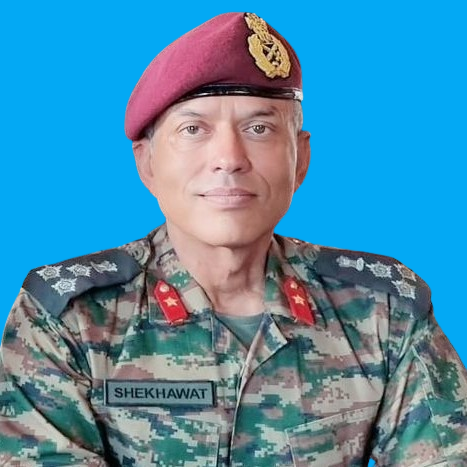
At the summit ridge of Mount Everest, Captain Saurabh Singh Shekhawat pressed forward despite illness, extreme cold, high winds and dangerously low oxygen, helping fellow climbers negotiate one of the mountain's most difficult passages. Seven years later, in the waters of Manipur, he would lead another extraordinary mission, taking his Special Forces team against an insurgent stronghold under heavy enemy fire. These two acts of courage, separated by mountains and battlefields, capture the remarkable military career of Brigadier Saurabh Singh Shekhawat, KC, SC, SM, VSM, one of India's distinguished Indian Army Special Forces officers.
Commissioned into the 17th Battalion of the Maratha Light Infantry on 11 June 1994 after graduating from the Indian Military Academy, Dehradun, Shekhawat subsequently joined the elite 21st Battalion of the Parachute Regiment (Special Forces). His career took him through demanding counter-insurgency service, specialised military assignments and leadership responsibilities, eventually including command of 21 Para (SF).
His Shaurya Chakra citation, effective 21 May 2001, commemorates his exceptional courage during the Indian Army Everest Expedition. After falling ill and being evacuated from the Everest region, he recovered, returned to Camp III and rejoined his team. During the summit attempt, he repeatedly encouraged and assisted fellow climbers across the treacherous Hillary Step, despite extreme weather, severe winds and oxygen deprivation. He successfully reached the summit of Mount Everest at 8:30 a.m. on 23 May 2001.
His Kirti Chakra citation, effective 8 September 2008, records an equally remarkable act of battlefield leadership. As Lieutenant Colonel and team leader of 21 Para (SF), Shekhawat established an intelligence network and directed 45 days of surveillance, planning and preparation to locate an insurgent camp in Bishnupur district, Manipur. During the night of 8–9 September 2008, he led his men through weed-infested waters towards the island stronghold. When the assault force came under heavy fire, he and a fellow soldier deliberately exposed themselves to enemy fire, eliminating another terrorist and diverting the attackers' attention. His actions prevented casualties among his men and enabled the remaining assault group to neutralise the camp. His official citation praised his resolute leadership, mission dedication, raw courage and presence of mind in close combat.
Shekhawat also received the Sena Medal, approved under Presidential Gazette notification No. 32-Pres/2008 for acts of exceptional courage, and the Vishisht Seva Medal for distinguished service of a high order. Together, these honours recognise his contributions to operational gallantry, leadership and professional service.
Beyond the battlefield, Shekhawat established an exceptional mountaineering record, summiting Mount Everest three times, in 2001, 2003 and 2005. His achievements also include climbs of Mount Kilimanjaro and Mont Blanc, and leadership of an Indo-Kazakh mountaineering expedition to Marble Wall in Kazakhstan. He additionally served as a United Nations Military Observer in the Democratic Republic of the Congo. During the 2020 India-China border crisis, he served as commander in the Galwan sector, contributing to India's military preparedness along the sensitive frontier.
Promoted to Brigadier in March 2020, Saurabh Singh Shekhawat retired from the Indian Army on 31 August 2024 after three decades of distinguished service. His legacy reflects the demanding spirit of the Para Special Forces: courage under fire, endurance in the world's harshest environments and an unwavering commitment to the men entrusted to his leadership.
Become the named supporter for this profile and edit the tribute biography and portrait (Owner account required). Proceeds help keep the archive online.
$25 USD / year — annual sponsorship renewal. Keeps the page online and, where enabled, the family anniversary remembrance emails active.