★
Loading archive…
Loading archive…
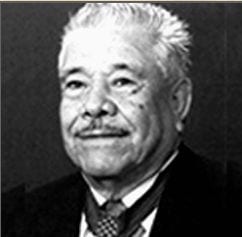
Sergeant, U.S. Army
Support & adopt this hero ↓
Silvestre S. Herrera: The Mexican-Born U.S. Army Soldier Who Fought On After Losing Both Feet
When a minefield severed both his feet, Silvestre S. Herrera refused to stop fighting. Lying wounded under intense enemy fire, he continued firing his rifle to hold down a German machine-gun position, giving his fellow soldiers the opportunity to outflank and capture it. His extraordinary courage near Mertzwiller, France, on 15 March 1945, would make him one of the most remarkable American soldiers of World War II and the recipient of both the United States Medal of Honor and Mexico's highest military recognition for valor.
Silvestre Santana Herrera was born on 31 December 1916 in Camargo, Chihuahua, Mexico. Following the deaths of his parents during an influenza outbreak, he was brought to El Paso, Texas, by his uncle when he was approximately eighteen months old. He was raised in Texas and later Phoenix, Arizona, believing that the man who raised him was his father. In January 1944, when he received his U.S. Army draft notice, Herrera discovered the truth about his Mexican birth and citizenship. Although he was informed that he could decline military service, he chose to serve the country where he had built his life and raised his family.
Assigned to Company E, 142nd Infantry Regiment, 36th Infantry Division, known as the Texas Division, Herrera served as a Private First Class during the European campaign. On 15 March 1945, near Mertzwiller, France, his platoon came under heavy German machine-gun fire along a wooded road. When the other soldiers took cover, Herrera launched a one-man frontal assault against the first enemy strongpoint, forcing eight German soldiers to surrender. As his platoon advanced, a second machine-gun position opened fire from beyond an extensive minefield. Herrera again moved forward, determined to neutralize the threat. While negotiating the minefield, he stepped on a landmine that severed both his feet. Despite severe pain and considerable blood loss, he continued firing accurately at the enemy position, preventing its defenders from concentrating their fire while an American squad moved around the minefield and captured the gun. His actions helped secure two enemy strongpoints and eight prisoners.
For this extraordinary act of gallantry and self-sacrifice, Herrera received the Medal of Honor. War Department General Orders No. 75, dated 5 September 1945, formally recognized his conspicuous courage and extraordinary heroism in combat. President Harry S. Truman personally presented the decoration to him at the White House on 23 August 1945. His devastating combat wounds were also recognized with the Purple Heart.
Herrera's World War II service is further represented by the American Campaign Medal, the European-African-Middle Eastern Campaign Medal with one Bronze Service Star for the Rhineland Campaign, and the World War II Victory Medal. His courage also received extraordinary recognition from his country of birth. In 1946, Mexico awarded him the Premier Mérito Militar, identified in the American Battle Monuments Commission's World War II Memorial Registry as the Order of Military Merit, First Class. He became internationally distinguished as the recipient of both the American Medal of Honor and Mexico's equivalent military recognition for valor.
Following his recovery and discharge from the Army as a sergeant, Herrera returned to civilian life with his wife, Ramona Hidalgo Herrera, and their family. He settled in Phoenix, Arizona, where he raised seven children. Using the opportunities provided by the GI Bill, he pursued further education and built a livelihood as a leather artisan and silversmith. Despite the extraordinary recognition he received, Herrera remained humble about his wartime actions and preferred to regard his service as a responsibility to his fellow soldiers rather than a personal achievement.
His legacy continued throughout Arizona. In 1945, the state designated 14 August as Herrera Day. A Phoenix elementary school and a street were named in his honour, and the United States Army dedicated the Silvestre S. Herrera Army Reserve Training Center in Mesa in 2004. He was also inducted into the Arizona Veterans Hall of Fame in 2001.
Silvestre S. Herrera died in Glendale, Arizona, on 26 November 2007, and was laid to rest at Resthaven Park Cemetery with full military honours. His story remains an enduring testament to courage, sacrifice, loyalty and determination. From a Mexican-born young man who voluntarily chose to serve the United States to a wounded infantryman who continued fighting when survival itself seemed impossible, Herrera demonstrated that true heroism is measured not by what a soldier receives, but by what he is willing to give for those beside him.
Become the named supporter for this profile and edit the tribute biography and portrait (Owner account required). Proceeds help keep the archive online.
$25 USD / year — annual sponsorship renewal. Keeps the page online and, where enabled, the family anniversary remembrance emails active.