★
Loading archive…
Loading archive…
Yeoman, U.S. Navy
Support & adopt this hero ↓He Kept the Ammunition Moving Through Enemy Fire
Biography
Thomas E. Atkinson was born in 1824 in Salem, Massachusetts. His naval career began long before the American Civil War, giving him years of experience at sea before the conflict that would ultimately bring him the Medal of Honor. During the 1840s he served as a petty officer aboard USS Congress, including operations connected with American naval activity off Montevideo. This early service established him as an experienced sailor well before the United States entered its greatest internal conflict.
Atkinson later joined USS Richmond in September 1860. When the Civil War began the following year, Richmond became heavily involved in Union naval operations, placing Atkinson in a series of important campaigns along the Gulf Coast and Mississippi River. His service took him through some of the Union Navy’s most difficult operations, including fighting around Fort McRee and Head of Passes and the campaign against the Confederate defenses below New Orleans.
In April 1862, Richmond participated in Flag Officer David G. Farragut’s operation against Fort Jackson and Fort St. Philip, the powerful Confederate fortifications guarding the lower Mississippi River. The fleet’s successful passage of those defenses opened the way toward New Orleans. Atkinson subsequently served during operations involving the Chalmette batteries and Confederate naval forces and was present during the campaign that resulted in the surrender of New Orleans.
His wartime experience continued as Union naval forces pushed farther along the Mississippi. Richmond participated in operations around Vicksburg and Port Hudson, where Confederate fortifications presented formidable obstacles to Federal control of the river. These repeated campaigns exposed Atkinson to the demanding realities of naval warfare: prolonged operations, fortified shore batteries, hostile vessels, and the constant responsibility of keeping a fighting ship functioning under combat conditions.
By 1864, Atkinson held the rating of Yeoman aboard USS Richmond. Although a yeoman’s normal duties involved administrative and clerical responsibilities, his role during battle could become very different. That became especially clear during one of the Civil War’s most famous naval engagements—the Battle of Mobile Bay.
Mobile remained an important Confederate port on the Gulf of Mexico, protected by forts, naval mines then commonly called torpedoes, Confederate gunboats, and the powerful ironclad ram CSS Tennessee. Rear Admiral David G. Farragut assembled a major Union force to enter the bay and break those defenses. On August 5, 1864, Richmond advanced with Farragut’s fleet into the heavily defended waters.
During the battle, Atkinson was given sole responsibility for supplying rifle ammunition aboard Richmond. It was a vital task. Ammunition had to continue reaching the men who needed it while the ship remained under enemy fire and the battle raged around the crew. Any interruption could reduce the vessel’s ability to defend itself and support the wider attack.
Atkinson carried out that responsibility throughout the morning and forenoon fighting. His official recognition emphasized the coolness and energy with which he maintained the ammunition supply during the engagement. Rather than being celebrated for commanding a gun or holding senior rank, he was recognized for performing an essential combat duty with exceptional steadiness while Richmond operated in a dangerous and chaotic battle environment.
The Union fleet succeeded in forcing its way into Mobile Bay. Confederate vessels were defeated or captured, and CSS Tennessee was eventually surrounded and compelled to surrender after fighting the Federal ships. The victory significantly reduced Confederate naval power in the Gulf and tightened Union control over one of the South’s most important remaining ports.
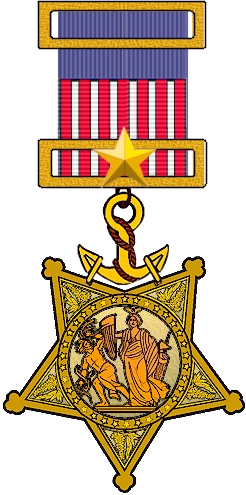
For his conduct during the Battle of Mobile Bay on August 5, 1864, Thomas E. Atkinson was awarded the Medal of Honor. His recognition was recorded in General Order No. 45 on December 31, 1864. The award specifically honored his performance aboard USS Richmond and the determination with which he maintained the ship’s rifle-ammunition supply during the battle.
The Medal of Honor was still a relatively new decoration during the Civil War. Atkinson therefore belonged to the early generation of sailors whose wartime conduct helped establish the Navy tradition of the nation’s highest military award. His recognition demonstrated that extraordinary service in battle was not limited to commanding officers or men operating the largest guns. Keeping ammunition moving under enemy fire could be just as critical to a ship’s ability to fight.
Atkinson continued his naval career after the Civil War. His long service had already carried him from antebellum naval operations through major Civil War campaigns at New Orleans, Vicksburg, Port Hudson, and Mobile Bay. These years gave his Medal of Honor action a broader context: Mobile Bay was not an isolated encounter, but the culmination of extensive experience in active naval operations.
His Civil War service was later encompassed by the Navy Civil War Campaign Medal, established in 1908 to recognize qualifying Navy and Marine Corps service during the conflict. Atkinson had died four decades before that decoration was created, so it was not a medal he personally wore during his lifetime. Instead, it represents the later formal recognition of the Civil War naval service in which he had participated so extensively.
Thomas E. Atkinson died on March 9, 1868, while aboard USS Dacotah. He was buried on San Lorenzo Island, Peru, far from his birthplace in Massachusetts and far from the waters of Mobile Bay where he had earned the Medal of Honor.
His legacy rests on a career of sustained naval service and a single responsibility carried out with exceptional determination during one of the Civil War’s decisive naval battles. While USS Richmond fought through Mobile Bay, Atkinson ensured that ammunition continued reaching the men who needed it. His calm performance under fire earned him the Medal of Honor and preserved his place among the decorated sailors of the United States Navy.
Become the named supporter for this profile and edit the tribute biography and portrait (Owner account required). Proceeds help keep the archive online.
$25 USD / year — annual sponsorship renewal. Keeps the page online and, where enabled, the family anniversary remembrance emails active.