★
Loading archive…
Loading archive…
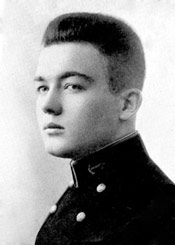
Rear Admiral, U.S. Navy
Support & adopt this hero ↓
A burning hotel, a city shattered by earthquake, and a woman trapped inside. On 1 September 1923, Thomas John Ryan Jr. entered the chaos of Yokohama and saved a life at extraordinary personal risk. Two decades later, the same U.S. Navy officer would command destroyers against Japanese forces in some of the fiercest surface actions of the Pacific War, earning two Navy Crosses and retiring as a Rear Admiral. Few American naval careers connect peacetime heroism and World War II combat leadership as dramatically as Ryan's.
Thomas John Ryan Jr. was born in New Orleans, Louisiana, on 5 August 1901. He attended Tulane University before entering the United States Naval Academy and was commissioned an ensign in June 1920. Early assignments aboard USS Salem, USS Zane and USS Abarenda were followed by an unusual and important posting. In November 1922, Ryan was sent to the American Embassy in Tokyo as a Japanese language officer. That assignment placed him in Japan when one of the country's worst natural disasters struck.
On 1 September 1923, the Great Kanto earthquake devastated Tokyo and Yokohama. Buildings collapsed, fires spread rapidly through the city, and the Grand Hotel in Yokohama was engulfed in flames. Ryan entered the burning building and rescued a woman who otherwise faced almost certain death. His official Medal of Honor citation stated that he acted with “complete disregard for his own life” and personally extricated the woman from the hotel. President Calvin Coolidge presented Ryan with the Medal of Honor at the White House on 15 March 1924.
There is a small historical detail hidden inside the Medal of Honor record. Ryan's citation identifies him as an Ensign, but the official Navy biographical record notes that the 1924 Navy Register dated his promotion to Lieutenant Junior Grade from 5 June 1923, nearly three months before the earthquake. The discrepancy belongs to the historical record, but it does not affect the award itself.
Ryan continued building an unusually broad naval career. He served as a Presidential Naval Aide, studied law while assigned to the Office of the Judge Advocate General, received a law degree from George Washington University, served aboard USS Arizona, completed the Naval War College junior course, and held senior staff assignments within the Battle Force and U.S. Fleet. In January 1940 he took command of USS Hale, and in 1942 he became Commander, Destroyer Division Twenty-Four. By June of that year he had been promoted to Captain.
The Pacific war transformed Ryan from an experienced naval officer into a combat commander. In early 1943 he commanded a transport division during Operation CLEANSLATE, the occupation of the Russell Islands. The official naval history of the operation identifies Commander Thomas J. Ryan as commander of Task Unit 61.1.4, part of the force assembled for the amphibious operation. That service forms one of the verified campaign credits represented by the bronze stars on his Asiatic-Pacific Campaign Medal.
His most celebrated wartime service came as commander of Destroyer Squadron Twelve during the Central Solomons campaign. On 30 June 1943, during the initial assault on Rendova Island, Ryan directed the destroyers covering American landing forces while Japanese aircraft repeatedly attacked. His first Navy Cross citation praised his “extraordinary heroism and distinguished service,” noting that his handling of the squadron protected both his ships and the transports they were screening.
Ryan did not have to wait long for another test. During offensive action at Kula Gulf on 8 and 9 July 1943, he directed a torpedo attack against a Japanese formation. His second Navy Cross citation credited his force with contributing materially to the destruction of four and possibly five enemy vessels. Later operations around Vella Lavella saw Ryan's destroyers again engage Japanese forces with torpedoes and gunfire. The citation recorded the destruction of an enemy destroyer and several barges, together with damage to another destroyer. For these actions Ryan received a Gold Star in lieu of a second Navy Cross. A contemporary January 1944 Navy Bureau of Personnel bulletin also reported the two Navy Cross awards and highlighted his leadership in the Solomons.
His 1943 campaign continued beyond the New Georgia fighting. Ryan transferred to the staff of the Fifth Amphibious Force, Pacific Fleet, and participated in the invasion of the Gilbert Islands. His verified Pacific service therefore supports three bronze campaign stars on the Asiatic-Pacific Campaign Medal, representing the Consolidation of the Southern Solomons, the New Georgia Group operation and the Gilbert Islands operation under the Navy's campaign-credit system. The New Georgia regulations are especially important because Rendova, Kula Gulf, Kolombangara and related Vella Lavella operations fall within a single grouped campaign credit rather than generating a separate star for every battle.
Ryan's broader wartime service also established entitlement to the American Defense Service Medal with Fleet device, the American Campaign Medal, the World War II Victory Medal, and the Navy Occupation Service Medal. His prewar sea service aboard USS Hale falls within the American Defense Service Medal's qualifying period, with Navy regulations providing a bronze star on the service ribbon in place of the Fleet clasp. After the war, Ryan assumed command of the light cruiser USS Providence in March 1946. The official Navy Awards Manual lists Providence as qualifying for European occupation service from 17 November 1945 through 16 June 1946, directly overlapping Ryan's command.
Ryan's career also placed him at the center of one of the most controversial naval proceedings of the postwar era. While serving as head of the Department of Ordnance and Gunnery at the Naval Academy, he acted as Judge Advocate during the general court-martial of Captain Charles B. McVay III, commanding officer of USS Indianapolis when the cruiser was sunk in July 1945. Ryan later commanded USS Providence, became Director of the Naval Reserves for the Eighth Naval District in New Orleans, and finished his active career as Deputy Commander of the Military Sea Transportation Service, Gulf Area.
In June 1950, Thomas J. Ryan Jr. left active naval service and was advanced to Rear Admiral on the retired list. He had served the United States Navy for three decades, progressing from a young officer in the aftermath of World War I to a decorated destroyer commander in the Pacific and finally to senior naval leadership. He died in New Orleans on 28 January 1970 and was buried at Arlington National Cemetery.
Ryan's Medal of Honor and two Navy Crosses tell two very different stories of courage. The first came without an enemy present, when a young naval officer chose to enter a burning hotel to save another person's life. The next two came twenty years later amid aircraft attacks, torpedo battles and night fighting in the Solomon Islands. Together they define the legacy of Rear Admiral Thomas John Ryan Jr., Medal of Honor recipient, two-time Navy Cross recipient, World War II destroyer commander and veteran of the Pacific War, an officer whose career demonstrated that courage can take radically different forms while demanding the same willingness to accept personal responsibility when lives depend upon it.
Become the named supporter for this profile and edit the tribute biography and portrait (Owner account required). Proceeds help keep the archive online.
$25 USD / year — annual sponsorship renewal. Keeps the page online and, where enabled, the family anniversary remembrance emails active.