★
Loading archive…
Loading archive…

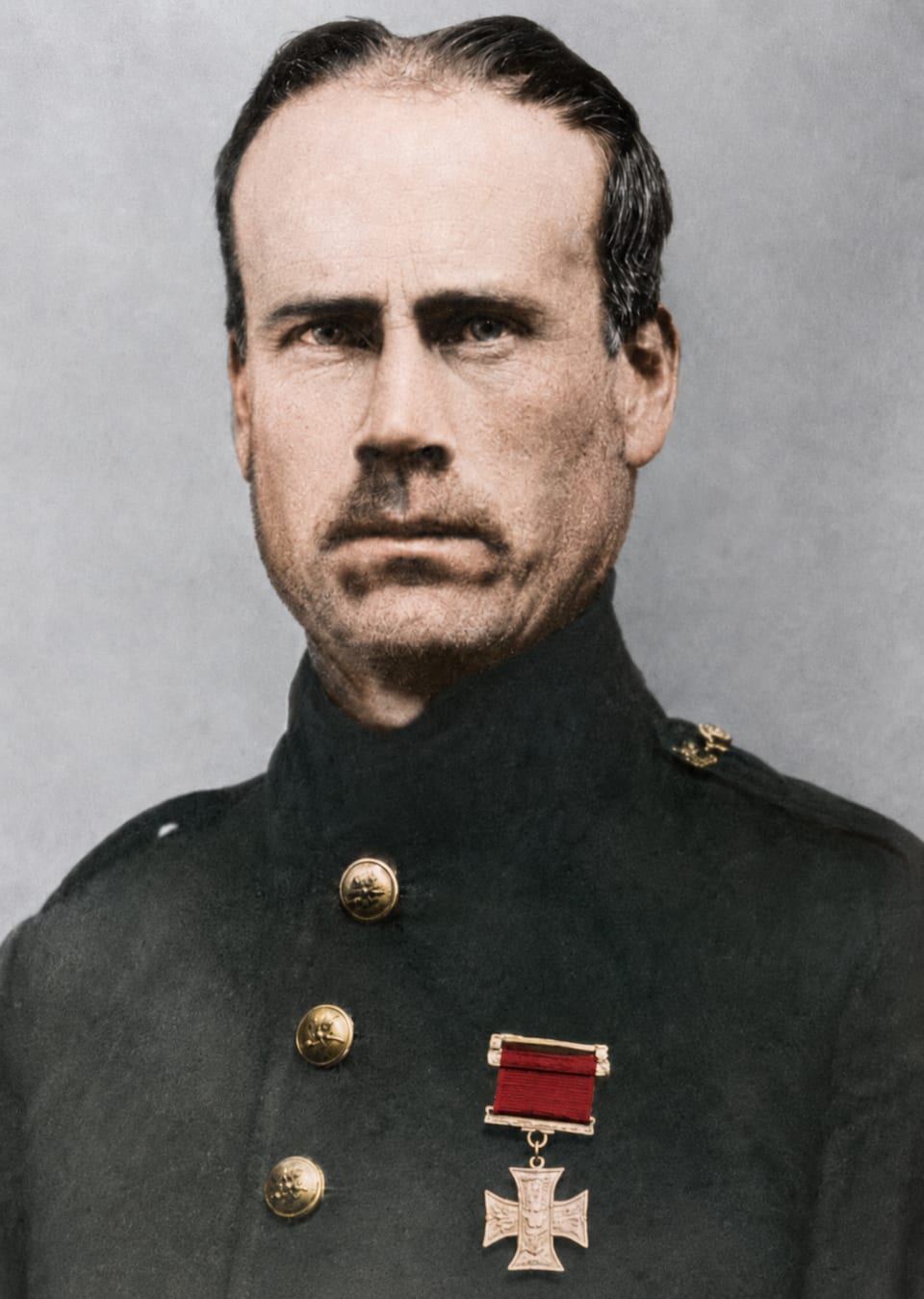
A burning railway carriage packed with ammunition threatened the lives of hundreds of passengers. While others hesitated, one young soldier stepped forward and risked everything to stop a disaster. His name was Private Timothy O’Hea, and his extraordinary courage would earn him the Victoria Cross.
Born in County Cork, Ireland, Timothy O’Hea served as a Private in the 1st Battalion, The Prince Consort’s Own Rifle Brigade, British Army. In 1866, his regiment was stationed in Canada during the Fenian troubles. On 9 June 1866, O’Hea was among four soldiers escorting an ammunition carriage attached to a passenger train carrying hundreds of German immigrants. When a fire broke out in the carriage at Danville Station, Quebec, the ammunition threatened to explode. As the danger became apparent, O’Hea took the keys from the escort sergeant, rushed into the burning carriage and called for water and a ladder. He repeatedly climbed the ladder and fought the flames, inspiring others to help until the fire was extinguished. His decisive action prevented a potential catastrophe and demonstrated extraordinary courage in the face of extreme danger.
For this remarkable act of bravery, Queen Victoria approved the award of the Victoria Cross, Britain's highest decoration for gallantry. His award was officially published in The London Gazette on 1 January 1867, Issue 23204, page 22. The citation specifically credited O’Hea's example with bringing the fire under control. His award was particularly remarkable because it was not earned in combat against an enemy. It was recognized under the 1858 Royal Warrant, which permitted the Victoria Cross to be awarded for conspicuous courage in extreme danger when life or public property could be saved. O’Hea remains an extraordinary figure in Victoria Cross history as the recipient of the only Victoria Cross awarded for an action on Canadian soil.
After leaving the British Army on medical grounds in 1868, O’Hea travelled to New Zealand, where he served in the mounted constabulary and later the mounted police. Seeking a new beginning, he moved to Australia in 1874 and joined explorer Andrew Hume and Lewis Thompson on an expedition into the Queensland interior. Their mission was connected with the search for a possible survivor of Ludwig Leichhardt's ill-fated 1848 expedition. The journey ended in tragedy. Hume and O’Hea perished during the expedition in November 1874, although historical accounts differ over the precise circumstances and the recovery of O’Hea's remains.
Even after his disappearance, O’Hea's Victoria Cross had a remarkable journey of its own. He had left the medal in Sydney before departing on the expedition. It was subsequently entrusted to the Art Gallery of New South Wales, where it was rediscovered in a drawer in 1950. It was eventually returned to the Rifle Brigade's regimental collection in Winchester, preserving the legacy of the young soldier whose courage had prevented a railway disaster.
Timothy O’Hea's story is a reminder that heroism is not defined by the battlefield alone. Sometimes, extraordinary courage is demonstrated in a moment when ordinary people hesitate, danger seems overwhelming, and one person chooses to act.
Become the named supporter for this profile and edit the tribute biography and portrait (Owner account required). Proceeds help keep the archive online.
$25 USD / year — annual sponsorship renewal. Keeps the page online and, where enabled, the family anniversary remembrance emails active.