★
Loading archive…
Loading archive…
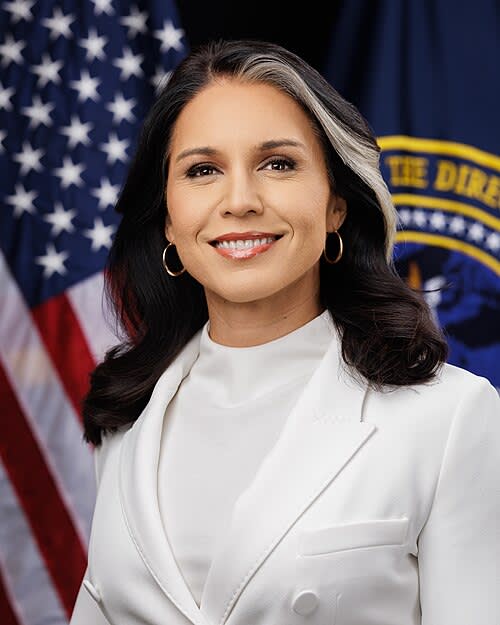
Lieutenant Colonel, U.S. Army
Support & adopt this hero ↓
The Combat Veteran Who Rose from Iraq to America’s Intelligence Leadership
Before Tulsi Gabbard entered the highest levels of United States national security, she served in a field medical unit in Iraq. Before she became a member of Congress, a presidential candidate and Director of National Intelligence, she was a young Hawaii Army National Guard soldier who stepped away from elected office to deploy with her unit. Her career has crossed battlefields, legislative chambers and the leadership of the American Intelligence Community, making her one of the most unusual public figures of her generation.
Tulsi Gabbard was born on 12 April 1981 in American Samoa. Her family moved to Hawaii when she was two years old, and she grew up in a household shaped by civic involvement, faith and the cultural diversity of the Pacific. At age 21, Gabbard was elected to the Hawaii House of Representatives, becoming the youngest person then elected to the state legislature and one of the youngest women ever elected to public office in the United States.
Political success could have provided Gabbard with a comfortable path forward. Instead, in April 2003, she enlisted in the Hawaii Army National Guard. When the 29th Infantry Brigade Combat Team mobilized for Operation Iraqi Freedom, she chose not to seek reelection and deployed with her unit. Serving in medical operations and logistics at Logistical Support Area Anaconda, she spent twelve months in Iraq supporting soldiers in an environment threatened by insurgent attacks, rockets and roadside bombs. Her service during that deployment earned her the Combat Medical Badge in 2005.
That first deployment changed the direction of her military career. After returning from Iraq, Gabbard completed officer training and received her commission as a second lieutenant in 2007. When the 29th Infantry Brigade Combat Team was activated again, she deployed to Kuwait from 2008 to 2009 as a Military Police platoon leader. The assignment placed her in command of soldiers and required her to move from the technical responsibilities of enlisted medical support into the demands of operational leadership.
Gabbard continued to balance military service with public responsibilities. She served as a legislative aide to United States Senator Daniel Akaka, won election to the Honolulu City Council and, in 2012, was elected to the United States House of Representatives. She represented Hawaii’s 2nd Congressional District for four terms from 2013 through 2021, serving on committees that included Armed Services, Homeland Security and Foreign Affairs. Her congressional career placed a combat veteran’s perspective inside debates over war, national security and the responsibilities owed to service members and veterans.
In 2020, after seventeen years in the Hawaii Army National Guard, Gabbard transferred to the United States Army Reserve and became a Civil Affairs officer. Her work expanded beyond conventional military policing and medical support into the relationship between military operations, governments and civilian populations. In 2021, she deployed as part of an Army Civil Affairs mission associated with Fort Bragg and the Horn of Africa. Her record continued to identify her as an Army Reserve Civil Affairs officer and lieutenant colonel during the process leading to her nomination as Director of National Intelligence.
Her military honours reflect more than two decades of active, National Guard and Reserve service. Her official Senate questionnaire records two awards of the Meritorious Service Medal, a Joint Service Commendation Medal received in 2021, a Navy Commendation Medal received in 2024, the Army Commendation Medal, Army Achievement Medal and Army Good Conduct Medal. It also confirms the National Defense Service Medal, Overseas Service Ribbon, Global War on Terrorism Service Medal and Combat Medical Badge.
Her reconstructed ribbon rack further reflects service connected with Iraq, expeditionary operations, Reserve mobilization and overseas duty. The Iraq Campaign Medal carries two bronze service stars because her January 2005 to January 2006 deployment crossed two officially designated campaign periods. Her Armed Forces Reserve Medal bears the mobilization device, while the oak leaf cluster on her Meritorious Service Medal represents a second award. These details reveal a career built not around a ceremonial association with the military, but around repeated mobilization and overseas service.
Gabbard’s public career continued to evolve after Congress. In 2020, she sought the Democratic nomination for president, becoming the first female combat veteran to run for the office. She later left the Democratic Party and became increasingly involved in national debates concerning foreign policy, intelligence, civil liberties and the use of American military power. Her political path attracted both strong support and sharp criticism, but her identity as a soldier remained central to her public image.
In 2025, Gabbard was confirmed by the United States Senate and sworn in as Director of National Intelligence. She became the eighth Senate-confirmed DNI and the first female combat veteran to hold the position. As DNI, she assumed responsibility for coordinating the work of the United States Intelligence Community and advising the president on intelligence related to national security. She continued to be publicly identified as a serving member of the United States Army Reserve.
Her appointment completed an extraordinary progression. The young state legislator who left elected office to deploy to Iraq had become the nation’s senior intelligence official. The enlisted medical specialist had become an Army Reserve lieutenant colonel. The soldier who once worked at a major logistics base in a combat zone was now responsible for helping integrate the intelligence produced by agencies operating around the world.
Tulsi Gabbard’s story is not defined by one deployment, one election or one appointment. It is defined by repeated transitions between military duty and public service. From Iraq and Kuwait to Congress, the Horn of Africa and the Office of the Director of National Intelligence, her career has placed her at the intersection of war, politics and national security. As of 2026, she continues to serve as Director of National Intelligence, making her one of the most prominent combat veterans in contemporary American government.
Become the named supporter for this profile and edit the tribute biography and portrait (Owner account required). Proceeds help keep the archive online.
$25 USD / year — annual sponsorship renewal. Keeps the page online and, where enabled, the family anniversary remembrance emails active.