★
Loading archive…
Loading archive…
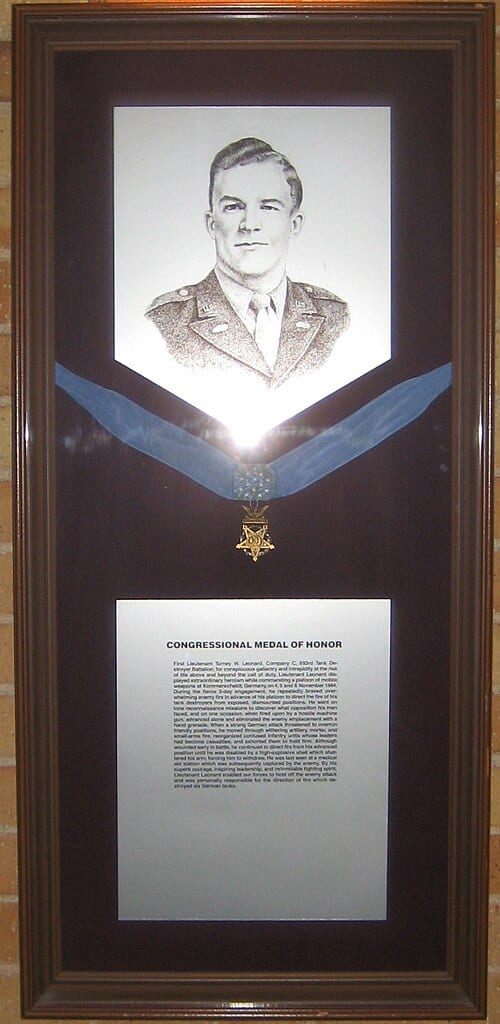
First Lieutenant, U.S. Army
Support & adopt this hero ↓
At Kommerscheidt, Germany, in November 1944, as German forces launched a determined assault against American positions, First Lieutenant Turney White Leonard repeatedly moved into the heart of enemy fire. Rather than command from safety, he led from the front, directing tank destroyer fire, undertaking dangerous reconnaissance missions, and rallying infantrymen under overwhelming attack. His extraordinary courage helped prevent an enemy breakthrough and earned him America's highest military decoration, the Medal of Honor.
Born on June 18, 1921, in Dallas, Texas, Leonard developed his leadership abilities through education and military training. He entered Texas A&M University in September 1938, joined the Corps of Cadets, and distinguished himself academically and militarily. Graduating on May 16, 1942, with a degree in agricultural administration, he received a commission as a Second Lieutenant in the Regular Army. Following specialized training at the Tank Destroyer Center at Camp Hood, Texas, he was assigned to Company C, 893d Tank Destroyer Battalion, in early 1943. He subsequently advanced to First Lieutenant and became a platoon leader.
After arriving in England in January 1944, Leonard and his battalion landed in Normandy on July 1. They fought through Normandy and Northern France before advancing towards the German frontier and the formidable Siegfried Line. By November, Company C was supporting the 28th Infantry Division during the brutal fighting in the Hürtgen Forest.
Between November 4 and 6, 1944, near Kommerscheidt, Leonard displayed exceptional heroism. He repeatedly exposed himself to enemy artillery, mortar, and machine-gun fire to direct his tank destroyer's weapons. During a reconnaissance mission, he advanced alone against a German machine-gun position and destroyed it with a hand grenade. When a powerful German assault threatened American positions, he reorganized disoriented infantry units whose leaders had become casualties and encouraged the soldiers to maintain their defence. Although wounded, Leonard refused to abandon his command. He continued directing fire until a high-explosive shell shattered his arm, forcing him to withdraw towards a medical aid station. The station was subsequently captured by German forces, and Leonard was never seen alive again.
His Medal of Honor citation, issued under War Department General Orders No. 74 on September 1, 1945, recognized his extraordinary courage, inspiring leadership, and decisive contribution to the destruction of six German tanks. The Medal was awarded posthumously and presented to his mother in Dallas on October 24, 1945. His remains were not recovered until November 1949, and he was buried at Grove Hill Memorial Park in Dallas on May 31, 1950.
Leonard's Purple Heart recognized the wounds he sustained in combat, while his American Campaign Medal, European-African-Middle Eastern Campaign Medal with three Bronze Service Stars, and World War II Victory Medal reflect his wartime service. His legacy also lives on at Texas A&M University, where the Leonard Corps Residence Hall honours his memory. His Medal of Honor and Aggie Ring are preserved as reminders of his extraordinary service.
First Lieutenant Turney White Leonard remains a remarkable example of courage, selflessness, and leadership under fire. His actions at Kommerscheidt demonstrated that true command is measured not by the safety of one's position, but by the willingness to share the dangers faced by those entrusted to one's leadership.
Medal of Honor citation
He displayed extraordinary heroism while commanding a platoon of mobile weapons at Kommerscheidt, Germany, on 4, 5, and 6 November 1944. During the fierce three-day engagement, he repeatedly braved overwhelming enemy fire in advance of his platoon to direct the fire of his tank destroyer from exposed, dismounted positions. He went on lone reconnaissance missions to discover what opposition his men faced, and on one occasion, when fired upon by a hostile machine gun, advanced alone and eliminated the enemy emplacement with a hand grenade. When a strong German attack threatened to overrun friendly positions, he moved through withering artillery, mortar, and small-arms fire, reorganized confused infantry units whose leaders had become casualties, and exhorted them to hold firm. Although wounded early in battle, he continued to direct fire from his advanced position until he was disabled by a high-explosive shell which shattered his arm, forcing him to withdraw. He was last seen at a medical aid station which was subsequently captured by the enemy. By his superb courage, inspiring leadership, and indomitable fighting spirit, 1st Lt. Leonard enabled our forces to hold off the enemy attack and was personally responsible for the direction of fire which destroyed six German tanks.
Become the named supporter for this profile and edit the tribute biography and portrait (Owner account required). Proceeds help keep the archive online.
$25 USD / year — annual sponsorship renewal. Keeps the page online and, where enabled, the family anniversary remembrance emails active.