★
Loading archive…
Loading archive…
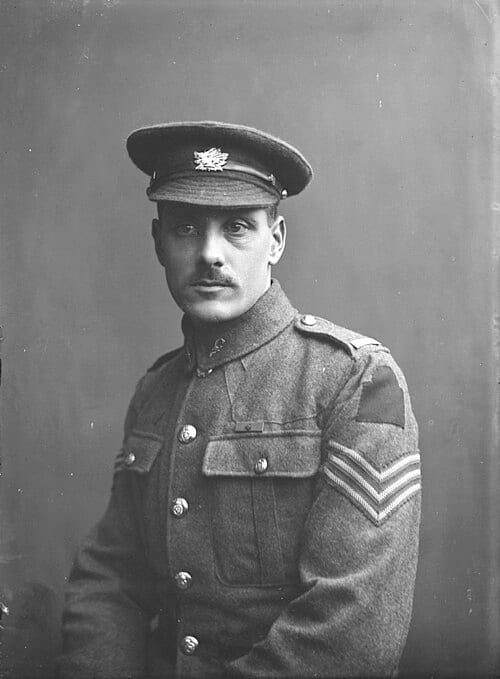
Forty enemy soldiers captured. A wounded comrade rescued under relentless machine-gun fire. Three extraordinary acts of courage in just three days. During the First World War, Walter Leigh Rayfield accomplished all three, earning the Victoria Cross and securing his place among Canada's most remarkable military heroes.
Born in Richmond, England, Rayfield experienced a difficult childhood before beginning a new life in Canada, where he worked on farms and in the lumber industry. In July 1917, he enlisted in the Canadian Expeditionary Force and eventually reached the Western Front as a private with the 7th Battalion, known as the 1st British Columbia Regiment. By September 1918, he was fighting through heavily defended German positions along the Drocourt-Quéant Line, east of Arras, France.
Between 2 and 4 September 1918, Rayfield demonstrated astonishing courage during the Canadian advance. Rushing ahead of his company, he stormed an enemy trench, killed two German soldiers with his bayonet and captured ten others. Later, when a concealed German sniper was inflicting casualties on Canadian troops, Rayfield advanced under sustained rifle fire, located the position and charged the trench with such determination that thirty more enemy soldiers surrendered.
Yet his most selfless act was still to come. Disregarding his own safety, Rayfield left protective cover under heavy machine-gun fire to carry a severely wounded comrade to safety. His actions demonstrated not merely extraordinary fighting ability, but an unwavering commitment to the lives of his fellow soldiers.
For these three acts of bravery, Private Walter Leigh Rayfield received the Victoria Cross. His official citation, published in the London Gazette, Issue No. 31067, in December 1918, praised his "indomitable courage, cool foresight, and daring reconnaissance" and described his conduct as an inspiration to all ranks. King George V personally presented him with the Victoria Cross at Buckingham Palace in March 1919.
Rayfield's wartime service was also recognized by the British War Medal and Victory Medal. The Belgian government honoured him with a distinction in the Royal Order of the Crown, an award acknowledged by Canada's Department of National Defence and represented in his surviving medal group. He also received the King George VI Coronation Medal in 1937, a commemorative honour awarded to surviving Victoria Cross recipients.
But Rayfield's commitment to service continued long after the guns fell silent. He subsequently served as an officer in the Queen's York Rangers, became Sergeant-at-Arms of the Legislative Assembly of Ontario and later served as Governor of Toronto's Don Jail. His postwar responsibilities reflected a life shaped by military courage, discipline and public duty.
Walter Leigh Rayfield died in Toronto on 19 February 1949 and was buried in Prospect Cemetery. His Victoria Cross and accompanying medals are preserved by the Canadian War Museum in Ottawa.
His legacy extends beyond the German prisoners he captured or the battlefield positions he overcame. It lives in the wounded soldier he refused to abandon and in the extraordinary courage of a Canadian private who repeatedly placed duty and humanity above his own survival.
Become the named supporter for this profile and edit the tribute biography and portrait (Owner account required). Proceeds help keep the archive online.
$25 USD / year — annual sponsorship renewal. Keeps the page online and, where enabled, the family anniversary remembrance emails active.