★
Loading archive…
Loading archive…
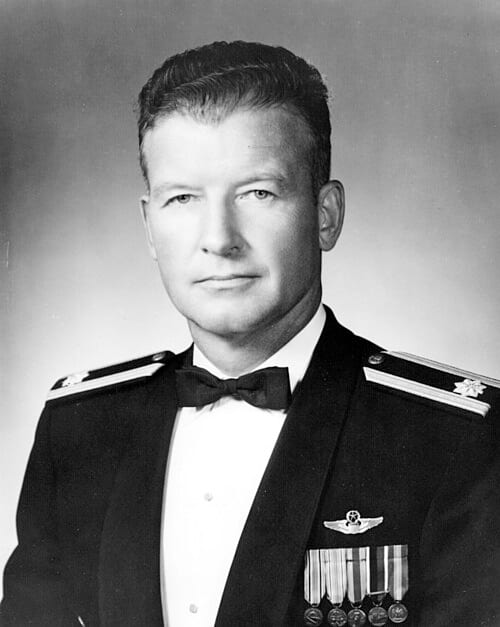
With his cockpit engulfed in flames, his aircraft badly damaged, and severe burns tearing through his body, Colonel William A. Jones III faced an impossible decision. He could abandon his aircraft and save himself, or fight to bring back information that might save another American airman. He chose his fellow pilot.
William Atkinson Jones III was born on 31 May 1922 in Norfolk, Virginia. Raised in Warsaw and Charlottesville, he demonstrated exceptional academic ability from an early age. He graduated from the University of Virginia at nineteen with a degree in Spanish before entering the United States Military Academy at West Point in 1942. Graduating in 1945, he received his commission in the Army Air Corps and began a distinguished career in military aviation.
Following the establishment of the independent United States Air Force in 1947, Jones continued his service as a versatile military aviator. His career included assignments in the Philippine Islands and Europe, strategic bomber operations, transport aviation, and two tours as a B-47 aircraft commander. He later attended the Air War College and earned a master's degree in international affairs in 1965. Despite his growing responsibilities as a senior officer, his passion remained operational flying.
In 1968, then Lieutenant Colonel Jones took command of the 602nd Special Operations Squadron at Nakhon Phanom Royal Thai Air Base, Thailand. On 1 September 1968, he led an A-1H Skyraider flight supporting the rescue of a downed F-4 Phantom pilot, Captain Jack Wilson, near Dong Hoi, North Vietnam. As the on-scene commander, Jones located the stranded airman but encountered intense enemy antiaircraft fire. Refusing to risk hitting the survivor, he initially withheld his attack before exposing himself to enemy fire and striking the hostile gun position with cannon and rockets.
During his second attack, enemy fire ignited the rocket-powered extraction system behind his seat, setting the aircraft's cockpit ablaze. Suffering severe burns to his face, neck, shoulders, arms and hands, Jones nevertheless maintained control of the crippled Skyraider. With his communications equipment disabled, he refused to abandon the aircraft. Instead, he flew approximately ninety miles back to his base in Thailand, landed safely, and relayed the downed pilot's location to a debriefing officer while receiving emergency treatment on the operating table. Captain Wilson was rescued later that day.
For this extraordinary act of courage and selflessness, Jones received the Medal of Honor posthumously. His official citation recognized his conspicuous gallantry and intrepidity at the risk of his life, above and beyond the call of duty. His other combat recognitions included the Distinguished Flying Cross, Air Medal, Air Force Commendation Medal and Purple Heart. His wider service record also reflects the American Campaign Medal, World War II Victory Medal, Army of Occupation Medal, National Defense Service Medal, Vietnam Service Medal, Air Force Longevity Service Award, Republic of Vietnam Gallantry Cross Unit Citation and Republic of Vietnam Campaign Medal.
Although Jones recovered sufficiently from his injuries to request another combat assignment, he was instead given command of the 1st Flying Training Squadron at Andrews Air Force Base, Maryland. Promoted to colonel in November 1969, he tragically died on 15 November 1969 in a private aircraft accident near Woodbridge, Virginia, at the age of forty-seven.
President Richard Nixon presented the Medal of Honor posthumously to his widow, Lois, on 6 August 1970. Jones also left behind a final intellectual legacy in his book, Maxims for Men-at-Arms: A Collection of Quotations by the Great and the Humble, whose first copy reached him just one day before his death.
Colonel William A. Jones III is remembered not simply for surviving an almost unsurvivable mission, but for placing another airman's life above his own. His actions near Dong Hoi remain a remarkable example of courage, leadership and devotion to fellow servicemen in the history of United States Air Force special operations.
Become the named supporter for this profile and edit the tribute biography and portrait (Owner account required). Proceeds help keep the archive online.
$25 USD / year — annual sponsorship renewal. Keeps the page online and, where enabled, the family anniversary remembrance emails active.