★
Loading archive…
Loading archive…
The Fearless U.S. Navy Diver Who Risked Everything to Save Lives Beneath the Sea
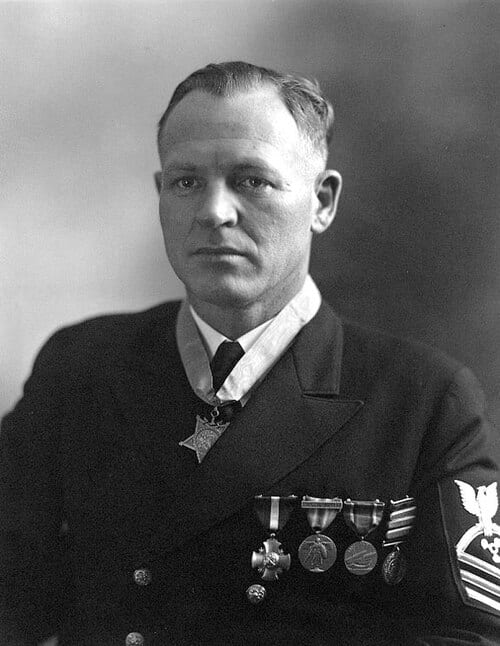
Two hundred and forty feet beneath the Atlantic Ocean, there was no rescue plan for the rescuers. Yet Chief Machinist's Mate William Badders descended anyway. His extraordinary courage during one of the most remarkable submarine rescue operations in U.S. Navy history would earn him the Medal of Honor and secure his place among America's greatest naval heroes.
Born in Harrisburg, Illinois, William Badders entered the U.S. Naval Reserve in August 1918 and joined the regular Navy in December 1919. His career soon took him into the dangerous world of deep-sea diving and submarine salvage, where technical skill, determination, and exceptional courage could mean the difference between life and death.
His heroism was recognized long before his most famous rescue. Between October 1925 and July 1926, Badders participated in the difficult salvage of the sunken submarine USS S-51. Serving as an Engineman First Class, he displayed what his Navy Cross citation described as "extraordinary heroism and devotion to duty." His growing expertise led to further commendations for the salvage of USS S-4 in 1928, the Japanese steamship Kaku Maru in 1932, and dangerous diving work to clear the propeller of USS Bittern in 1933. In April 1931, he had earned the prestigious qualification of Master Diver.
But the defining test of his career came on 23 May 1939, when the submarine USS Squalus sank during sea trials near Portsmouth, New Hampshire. Trapped approximately 240 feet below the surface, 33 surviving submariners awaited rescue while 26 of their shipmates had already perished. Badders joined the rescue effort aboard USS Falcon, helping operate the newly developed McCann rescue chamber that carried survivors to safety.
After the 33 survivors had been rescued, an even more dangerous mission remained. Badders and fellow diver John Mihalowski descended again to investigate the submarine's flooded after section, knowing that if either man became incapacitated, no one could reach them. Their hazardous journey confirmed that no additional survivors could be saved. Badders subsequently performed difficult underwater dives during the recovery of the submarine.
For his extraordinary actions, Badders received the Medal of Honor on 19 January 1940. His official citation recognized his exceptional courage throughout the rescue and salvage operations, praising conduct far beyond the ordinary demands of duty.
His distinguished service also brought the Navy and Marine Corps Medal, awarded in recognition of four earlier letters of commendation dated 1926, 1928, 1939, and 1940. His broader naval record included the Navy Good Conduct Medal, World War I Victory Medal, Yangtze Service Medal, and American Defense Service Medal, reflecting years of service across a changing era of American naval history.
Badders transferred to the Fleet Reserve in March 1940. He died on 23 November 1986 and was laid to rest at San Francisco National Cemetery.
William Badders left a legacy measured not simply by the medals he earned, but by the lives he helped save. From the wreck of USS S-51 to the desperate rescue of USS Squalus, his story remains an enduring example of courage, professional mastery, and devotion to others in the unforgiving depths of the sea.
Become the named supporter for this profile and edit the tribute biography and portrait (Owner account required). Proceeds help keep the archive online.
$25 USD / year — annual sponsorship renewal. Keeps the page online and, where enabled, the family anniversary remembrance emails active.