★
Loading archive…
Loading archive…
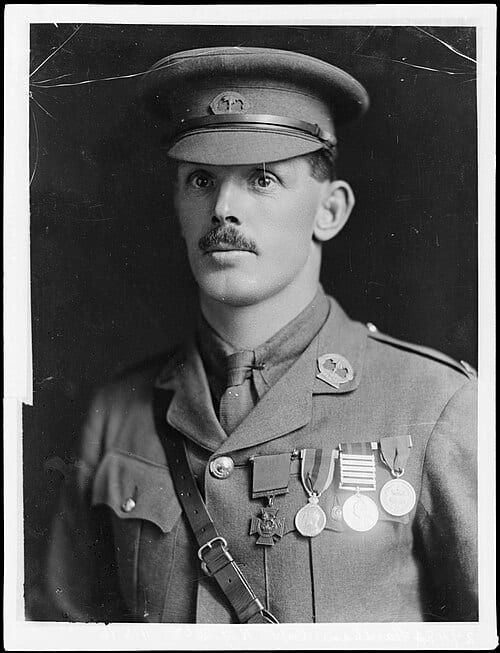
Major, New Zealand Army
Support & adopt this hero ↓
He gave a horse to a wounded man and ran beside it to cover.
William James Hardham was born in Wellington on 31 July 1876, the son of labourer George Hardham and Ann Gregory. He attended Mount Cook School and became a blacksmith. Rugby was an important part of his early life: he represented Wellington from 1897 and played for Petone. Alongside his trade and sport he joined the Wellington Naval Artillery Volunteers in 1895, transferring to the Petone unit the following year. Despite their title, these were Army militia units.
In March 1900 he volunteered for the Fourth New Zealand Contingent, the Rough Riders, as a farrier non-commissioned officer. He reached South Africa in May. On 28 January 1901 his section was caught by Boer fire near Naauwpoort in the Transvaal. As the New Zealanders prepared to withdraw, Trooper John McRae was wounded and his horse killed.
Hardham went back under heavy fire, dismounted and lifted McRae onto his own horse. He then ran alongside, guiding the animal and its injured rider until both were beyond immediate danger. The official citation describes this rescue during the section's engagement with approximately twenty Boers (London Gazette, 4 October 1901, issue 27362, page 6481; reproduced at https://www.birkenheadrsamedals.nz/vc-william-hardham.php). He was the only New Zealand serviceman awarded the Victoria Cross for the South African War.
He returned for further service as a lieutenant with the Ninth Contingent in 1902, then joined New Zealand's coronation contingent. The Prince of Wales presented his VC at Horse Guards Parade on 1 July. Back home, Hardham resumed rugby and served several terms on the Wellington Rugby Football Union's management committee, becoming a life member.
He volunteered again in 1914 and went to the Middle East as a captain in the Wellington Mounted Rifles. Severe wounds at Gallipoli on 30 May 1915 led to evacuation. During his convalescence he married Constance Evelyn Parsonson in March 1916. He later commanded Queen Mary Hospital at Hanmer Springs, then secured permission to return overseas. He served in Palestine in 1918 and became a major on 15 May.
Malaria brought him home in January 1919. His impaired health prevented a return to blacksmithing, so he worked for the Dominion newspaper and the Public Works Department. He also supported returned soldiers and helped organize Wellington's Anzac Day commemorations. Hardham died at home on 13 April 1928 and was buried at Karori. His wife survived him; they had no children.
Become the named supporter for this profile and edit the tribute biography and portrait (Owner account required). Proceeds help keep the archive online.
$25 USD / year — annual sponsorship renewal. Keeps the page online and, where enabled, the family anniversary remembrance emails active.