★
Loading archive…
Loading archive…
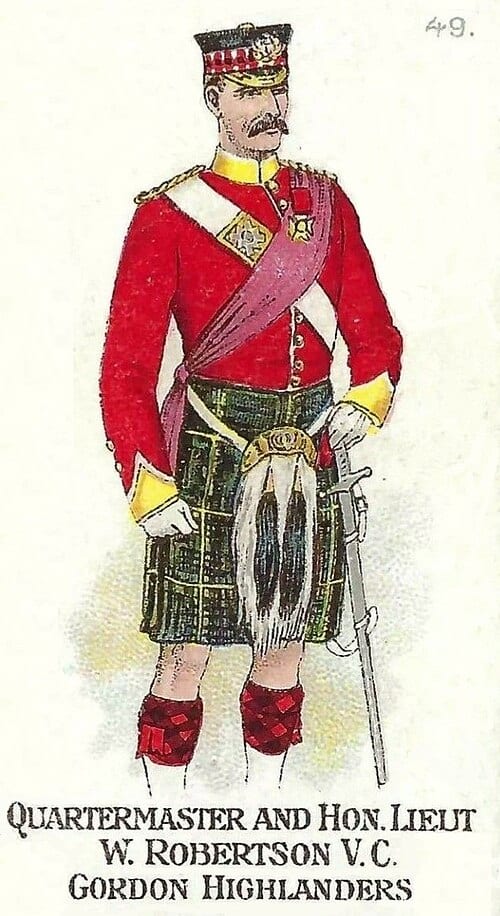
Lieutenant Colonel, British Army
Support & adopt this hero ↓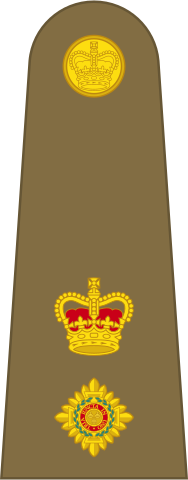
He led successive rushes and held a camp under hostile fire.
William Robertson was born in Dumfries on 27 February 1865 and joined the army on 1 December 1884. Service with the Gordon Highlanders took him to India and ultimately to the position of regimental sergeant-major. He married Sara Ferris in Belfast in 1891, and they raised a daughter and three sons. In October 1899 his battalion arrived in South Africa as war with the Boer republics began.
At Elandslaagte on 21 October, the Gordons helped attack a Boer position threatening communications near Ladysmith. Robertson moved forward with the assaulting soldiers rather than remaining behind them. As successive rushes carried the battalion uphill, he exposed himself to artillery and rifle fire to keep the advance moving. The capture of the main position did not end his part in the fighting: he took a small party onward to occupy the enemy camp and held it despite fire crossing the ground from different directions.
His Victoria Cross citation, published in the London Gazette on 20 July 1900, issue 27212, page 4509, records that he "led each successive rush" and continued encouraging his men until he had been wounded twice (https://www.thegazette.co.uk/London/issue/27212/page/4509). Brigadier Ian Hamilton witnessed the later phase and endorsed the recommendation. Robertson's South African service also included the defence of Ladysmith. Commissioned from the ranks in 1900, he received his Cross from Queen Victoria and was made a freeman of Dumfries.
During the First World War he worked in Edinburgh as a recruiting staff officer and rose to lieutenant-colonel. His family's service carried a heavy cost: his son Ian Gordon, an officer in the Gordons, was killed at Beaumont-Hamel. Robertson's own work continued in veterans' welfare. He became vice-president of Lady Haig's Poppy Factory and of the British Legion in Scotland, and received the French Legion of Honour in 1935. His appointment as Commander of the Order of the British Empire followed in 1946.
He lived in Portobello and died on 6 December 1949. His daughter arranged for his Cross and medals to be preserved at Edinburgh Castle; the Scottish United Services Museum received them in 1971, alongside medals belonging to his sons.
Become the named supporter for this profile and edit the tribute biography and portrait (Owner account required). Proceeds help keep the archive online.
$25 USD / year — annual sponsorship renewal. Keeps the page online and, where enabled, the family anniversary remembrance emails active.