★
Loading archive…
Loading archive…

Private William Stanlake’s Victoria Cross was earned through a feat of reconnaissance at extraordinarily close range. On 26 October 1854, during the Crimean action later known as Little Inkerman, volunteer sharpshooters of the 1st Battalion, Coldstream Guards, operated near Inkerman under Captain Gerald Littlehales Goodlake. Stanlake volunteered to reconnoitre a Russian position and crawled forward until he was within only six yards of an enemy sentry. Despite having been warned of the danger, he completed the reconnaissance and returned with information that enabled the officer commanding the party to effect a surprise. The Victoria Cross and George Cross Association places the action at Little Inkerman on 26 October 1854, while the official citation itself records the deed more generally as occurring in October.
Stanlake’s Victoria Cross was announced in the London Gazette on 24 February 1857 under the surname spelling Stanlock. The official citation states that he volunteered while serving as one of the sharpshooters, crawled to within six yards of a Russian sentry for reconnaissance purposes, and thereby enabled the officer in command to effect a surprise. It concludes that Stanlock had been warned beforehand of the imminent risk he would run “in the adventure.” That wording should be retained in preference to the previously quoted ending, “in the execution of this service.”
William Stanlake was born on 31 October 1830 at Uppacot Farm, Halwill, near Okehampton in Devon, the son of John Stanlock, a labourer, and Mary Stanlock. He worked as a labourer before joining the Coldstream Guards at Totnes in July 1852. Published specialist sources differ slightly over the precise date, with the Victoria Cross and George Cross Association giving 29 July and Victoria Cross Online referring to 27 July before elsewhere describing his service as beginning on 29 July. Until the original attestation record is checked, “July 1852” is the safest publication wording.
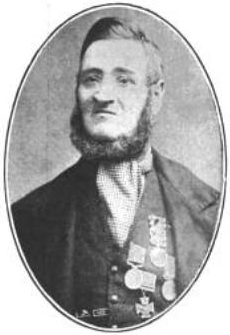
With the outbreak of the Crimean War, Stanlake served with the 1st Battalion, Coldstream Guards, Guards Brigade, 1st Division. His campaign service resulted in entitlement to the Crimea Medal with four clasps, Alma, Balaklava, Inkermann and Sebastopol, together with the Turkish Crimea Medal. He was also awarded the Distinguished Conduct Medal in 1855. These honours, together with the Victoria Cross, form the four decorations and medals consistently attributed to him by specialist Victoria Cross sources.
The surviving sources do not justify describing the four Crimea clasps as four devices on an undress ribbon. They were clasps attached to the full-size Crimea Medal. Accordingly, Stanlake’s historical biography should record his four clasp entitlements by name without implying that they were represented by four silver rosettes on his ribbon bar.
There is a significant conflict in the published accounts concerning the first public Victoria Cross investiture at Hyde Park on 26 June 1857. Victoria Cross Online and a specialist register of the first investiture state that Stanlake was not permitted to attend because he had recently been punished by his commanding officer for theft. The Victoria Cross and George Cross Association, however, lists his VC investiture as having taken place on 26 June 1857 and states that Queen Victoria presented the award. Because these accounts directly contradict one another, the claim that he either certainly attended or certainly missed the ceremony should not presently be presented as an uncontested fact without confirmation from a contemporary attendance list or Guards record.
On 1 July 1860 Stanlake married Frances Adelaide Collins at the Chapel Royal of St Peter ad Vincula in the Tower of London. She was the widow of Robert Baker Collins and the daughter of William Henry Kempthorn. Stanlake left the Coldstream Guards on 28 January 1863 after more than ten years of service. Despite receiving both the Victoria Cross and Distinguished Conduct Medal, he remained a Private throughout his military career.
After leaving the Army, Stanlake lived in South London. He died at Blue Anchor Lane, Camberwell, on 24 April 1904, aged seventy-three, and was buried in Camberwell Old Cemetery, Section 62, Grave 19075. A headstone was erected at his grave in 1987, and Victoria Cross Online records that it was replaced again in 2011.
Stanlake’s Victoria Cross is today held by the Coldstream Guards at Wellington Barracks in London. Sources specifically confirm the location of the Victoria Cross itself. I would therefore avoid the previous statement that his entire four-medal group is preserved there unless the Coldstream Guards Museum or another primary collection record confirms the whereabouts of all four medals.
Become the named supporter for this profile and edit the tribute biography and portrait (Owner account required). Proceeds help keep the archive online.
$25 USD / year — annual sponsorship renewal. Keeps the page online and, where enabled, the family anniversary remembrance emails active.