★
Loading archive…
Loading archive…
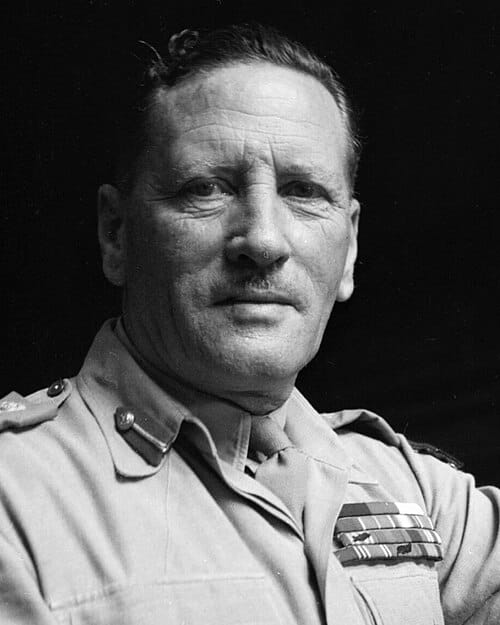
Field Marshal, British Army
Support & adopt this hero ↓
Before Bernard Montgomery became synonymous with El Alamein, Sir Claude John Eyre Auchinleck had already taken personal command of the Eighth Army and stopped the Axis advance into Egypt. One of the most senior commanders of the British Indian Army during the Second World War, Auchinleck commanded in Norway, India and the Middle East before returning to India to direct the enormous military organisation that sustained Allied operations against Japan. His career carried him through two world wars, the deserts of North Africa, the Burma campaign and finally the military upheaval surrounding the partition of India.
Claude John Eyre Auchinleck was born at Aldershot on 21 June 1884 into a military family, the son of an officer of the Royal Horse Artillery. Educated at Wellington College and the Royal Military College, Sandhurst, he joined the 62nd Punjabis in 1904 . He developed a deep knowledge of India, learned local languages and built a reputation for understanding the Indian soldiers with whom he served, beginning an association with the Indian Army that would define almost his entire military career.
During the First World War , Auchinleck saw active service in the Middle East and fought through the demanding Mesopotamian campaign against Ottoman forces. His service included operations around the heavily defended Sannaiyat position, where poorly prepared assaults against entrenched defenders demonstrated the terrible cost of attacking without adequate preparation. Auchinleck was awarded the Distinguished Service Order for his wartime service. His experiences in Mesopotamia profoundly influenced his approach to command, convincing him that soldiers' health, rest, hygiene, medical care, logistics and adequate supplies were essential foundations of battlefield success.
Auchinleck continued his Indian Army career during the inter-war years. He served as an instructor at the Staff College, Quetta , and held important commands on the North-West Frontier of India . His leadership of a brigade during operations in the Mohmand area in 1933 brought appointment as a Companion of the Order of the Bath in 1934 . By the outbreak of the Second World War in 1939, he was a major-general with extensive experience of command, frontier warfare and staff work.
Early in 1940 , Auchinleck was sent to Britain and commanded troops during the unsuccessful Norwegian campaign , including the expedition associated with Narvik. He subsequently held corps command and then Southern Command in Britain. Promoted to full general in November 1940 , he became Commander-in-Chief, India . His rapid dispatch of troops during the crisis in Iraq in 1941 earned the approval of Prime Minister Winston Churchill and demonstrated India's growing importance as a military base for British and Allied operations.
In July 1941 , Auchinleck became Commander-in-Chief, Middle East Forces , replacing General Sir Archibald Wavell. Known widely as “The Auk,” Auchinleck experienced both major successes and severe reverses during his thirteen months in command. Operation Crusader in November 1941 relieved Tobruk and forced Axis forces back, but the following year the British position deteriorated during the Gazala battles and the subsequent fall of Tobruk. In June 1942, as the crisis deepened, Auchinleck relieved Lieutenant-General Neil Ritchie and personally assumed command of the Eighth Army .
With Axis forces advancing toward the Nile Delta and the Suez Canal, Auchinleck organised the British defence at the First Battle of El Alamein in July 1942 . His army checked the German and Italian advance and denied Field Marshal Erwin Rommel the breakthrough he needed into Egypt. Auchinleck was unable to turn that defensive success into a decisive counter-offensive, and serious difficulties within the senior command structure remained. He also resisted pressure from Churchill to launch another major offensive before he believed the Eighth Army was properly prepared. In August 1942 , Churchill replaced him as Commander-in-Chief Middle East.
After a period without an active command, Auchinleck returned to India in June 1943 for a second term as Commander-in-Chief, India . His responsibilities now extended far beyond conventional field command. India became a vast recruiting, training, reinforcement and supply base for the Allied war in Asia, and Auchinleck directed the resources of the Army of India in support of General William Slim's Fourteenth Army . His logistical and organisational support proved vital to the Allied recovery in Burma, and Slim later acknowledged that his army could not have achieved its eventual victory without Auchinleck and the immense military system operating from India.
Auchinleck remained Commander-in-Chief as the Second World War ended and India moved toward independence. His promotion to Field Marshal took effect on 1 June 1946 . The official War Office announcement recorded him as General Sir Claude John Eyre Auchinleck, GCB, GCIE, CSI, DSO, OBE, Indian Army , formally raising him to the Army's highest rank and reflecting the extraordinary range of honours accumulated during more than four decades of service.
As partition approached, Auchinleck was given the formidable task of helping prepare the Indian Army for division between the new armed forces of India and Pakistan . After independence in August 1947, he briefly became Supreme Commander, India and Pakistan , overseeing the continuing military reorganisation of what had been one of the largest volunteer armies in the world. His tenure ended in November 1947 , bringing his long period of active service in the Indian subcontinent to a close.
Auchinleck strongly disliked the manner in which partition was being implemented. He refused a peerage because he did not want his name publicly associated with a policy he believed to be mistaken. He returned to Britain and, in later life, settled in Marrakesh, Morocco , maintaining the deep personal connection with India that had shaped his military career from its earliest years.
Sir Claude John Eyre Auchinleck died in Marrakesh on 23 March 1981 , aged 96. His career had stretched from the Indian Army of the early twentieth century through two world wars and the final dissolution of British rule in India. Remembered for Mesopotamia, the North-West Frontier, his command in North Africa, the stand at the First Battle of El Alamein, his immense contribution to sustaining the Burma campaign and his final responsibility for dividing the Indian Army, Auchinleck remains one of the most important and complex British Indian Army commanders of the twentieth century.
Become the named supporter for this profile and edit the tribute biography and portrait (Owner account required). Proceeds help keep the archive online.
$25 USD / year — annual sponsorship renewal. Keeps the page online and, where enabled, the family anniversary remembrance emails active.