★
Loading archive…
Loading archive…

Lieutenant-Commander, Royal Navy
Support & adopt this hero ↓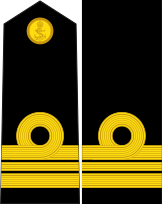
Rear Admiral Charles Conway Hartigan devoted more than three decades to the United States Navy, serving from the era of Theodore Roosevelt's "Great White Fleet" through the early years of the Second World War. Best remembered for his gallantry during the United States occupation of Veracruz in 1914, Hartigan earned the Medal of Honor for his calm leadership under intense enemy fire. His distinguished career encompassed combat command, diplomatic assignments, battleship command, and senior leadership, culminating in the rank of rear admiral.
Charles Conway Hartigan was born on 13 September 1882 in Danbury, Connecticut. After receiving an appointment to the United States Naval Academy, he graduated in 1906 and was commissioned as an ensign in the United States Navy. During the years before the First World War, he served aboard a variety of warships, gaining valuable experience as the Navy expanded its global presence and modernized its fleet.
Hartigan's defining moment came during the United States occupation of Veracruz, Mexico, on 22 April 1914. As a lieutenant, he commanded a naval company during the assault to seize the strategically important port. Advancing through streets swept by rifle and machine-gun fire, he led his men with exceptional courage and determination, maintaining discipline and momentum under difficult combat conditions. His conspicuous gallantry and effective leadership during the operation earned him the Medal of Honor, the United States' highest military decoration for valor. The award was presented under Navy General Order No. 177 in 1915.
Hartigan remained on active duty throughout the First World War, serving in a variety of operational and command assignments. His wartime service entitled him to the World War I Victory Medal, while his participation in the Veracruz campaign was recognized by the Mexican Service Medal. Continuing his naval career through the interwar period, he held increasingly senior appointments, including service as Naval Attaché in Peiping (Beijing), China, where he represented American naval interests during a period of significant political change in East Asia.
Promoted through the officer ranks, Hartigan later commanded the battleship USS Oklahoma (BB-37), one of the U.S. Navy's principal capital ships during the late 1930s. His leadership at sea and ashore reflected the professionalism and adaptability expected of senior naval officers during an era of rapid technological and strategic change. Remaining on active duty after the outbreak of the European war in 1939, he qualified for the American Defense Service Medal before retiring on 30 June 1941 with the rank of captain. In recognition of his long and distinguished service, he was subsequently advanced to the rank of Rear Admiral on the retired list.
Rear Admiral Hartigan spent his retirement supporting the Navy Department during the early years of the Second World War before passing away on 25 February 1944. He was laid to rest with full military honors at Arlington National Cemetery, where his service and sacrifice continue to be remembered.
Rear Admiral Charles Conway Hartigan's military decorations—the Medal of Honor, Mexican Service Medal, World War I Victory Medal, and American Defense Service Medal—reflect a career that spanned some of the most transformative decades in American naval history. From the streets of Veracruz to senior command in the interwar fleet, his steadfast leadership, courage under fire, and lifelong commitment to the United States Navy secured his place among the service's distinguished Medal of Honor recipients.
Become the named supporter for this profile and edit the tribute biography and portrait (Owner account required). Proceeds help keep the archive online.
$25 USD / year — annual sponsorship renewal. Keeps the page online and, where enabled, the family anniversary remembrance emails active.