★
Loading archive…
Loading archive…
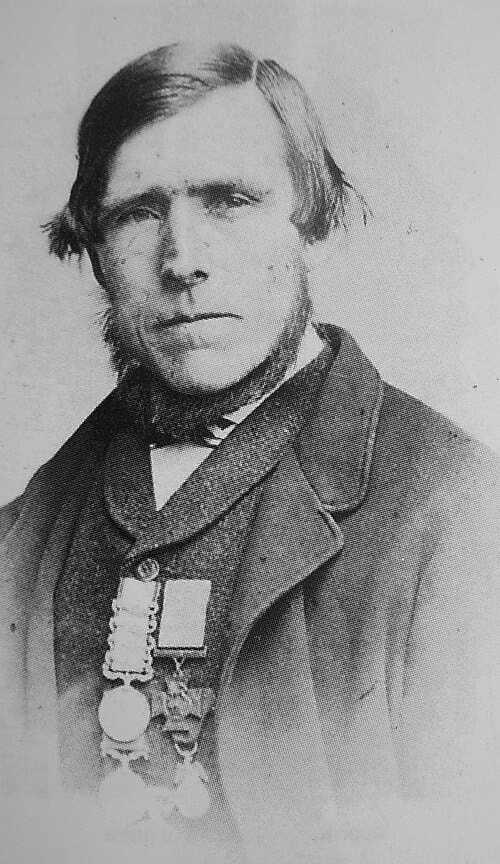
Sapper, British Army
Support & adopt this hero ↓
The Royal Engineer Who Faced the Redan Under Fire
Some acts of courage happen in seconds. Sapper John Perie's courage lasted long enough for him to lead men toward one of the most dangerous fortifications in the Crimea, survive a bullet wound to his side, and then deliberately return into the open to save another wounded man. On 18 June 1855, during the assault on the Redan at Sevastopol, Perie proved why the words "For Valour" would become permanently attached to his name.
Born in August 1829 at Huntly, Aberdeenshire, Scotland, John Perie entered the British Army and served as a sapper with the 8th Company, Royal Sappers and Miners, the military engineers whose work placed them at the centre of siege operations. By the time Britain and its allies went to war with Imperial Russia in the Crimean War, Perie's profession demanded much more than engineering skill. Sappers worked under fire constructing batteries, approaches, trenches and other siege works, frequently operating close to enemy positions. The Royal Engineers Museum identifies Perie as a member of the 8th Company and confirms his service at Sevastopol.
Perie's Crimean service was extensive. His Crimea Medal carried four clasps, recording participation in Alma, Balaklava, Inkermann and Sebastopol. These were not minor episodes in the campaign. The battles represented some of the most famous and punishing actions of the Crimean War, culminating in the long struggle for Sevastopol. His medal entitlement therefore tells a story larger than the single day on which he earned the Victoria Cross. It places him amid the major phases of one of Victorian Britain's hardest campaigns. The Victoria Cross and George Cross Association records his Crimea Medal and four-clasp entitlement alongside his other honours.
Yet it was 18 June 1855 that made John Perie one of the most distinguished soldiers in the history of the Royal Engineers.
British forces launched a major assault against the Great Redan, a formidable Russian defensive position protecting Sevastopol. The attackers had to cross exposed ground under intense enemy fire while attempting to carry the equipment necessary to overcome the fortifications. Among those moving forward was a ladder party involving sailors and Royal Engineers.
Perie did not remain behind the assault.
He went forward with the ladder party.
The original London Gazette of 24 February 1857 praised his "conspicuous valour in leading the Sailors with the ladders to the storming of the Redan." The official record went further, describing him as invaluable during the action.
That alone would have constituted exceptional conduct. What followed made Perie's actions even more remarkable.
During the assault, he was shot in the side. He had every justification to withdraw and seek treatment. Instead, when a wounded man remained exposed in the open and needed help, Perie went back into danger. The London Gazette recorded his devoted conduct in helping rescue the casualty despite having himself only recently been wounded.
There is a brutal simplicity to what happened. Perie had already advanced toward a fortified position under Russian fire. He had already been wounded. Then, knowing exactly how dangerous the exposed ground was, he returned because another man could not escape without help.
For those actions, Sapper John Perie was awarded the Victoria Cross.
His award appeared in the London Gazette on 24 February 1857, among the earliest Victoria Cross awards following the decoration's creation. A few months later, on 26 June 1857, Perie stood in Hyde Park, London, at the historic first great Victoria Cross investiture. There, Queen Victoria personally presented him with the Cross. The Royal Engineers Museum confirms both the presentation and the fact that Perie's Victoria Cross survives in its collection today.
Perie's service was recognized by more than the Victoria Cross. France awarded him the Médaille militaire, one of the country's distinguished military decorations, reflecting allied recognition of his service during the Crimean conflict. Specialist Victoria Cross records independently confirm his possession of the French decoration.
His recorded honours also include the Turkish Crimea Medal, another reminder that the Crimean War was fought by an international coalition, and the China Medal associated with his later service during the Second Anglo-Chinese War. The Victoria Cross and George Cross Association records both medals among Perie's honours.
Taken together, Perie's recorded medal group reflects an unusually active Victorian military career: the Victoria Cross, Crimea Medal with four clasps, China Medal, French Médaille militaire and Turkish Crimea Medal. The medals tell of service across two major conflicts and recognition from Britain and its allies, but the defining story remains the assault on the Redan.
After leaving military service, Perie returned to Scotland. His later life was far quieter than the events that had made him famous. He died in Aberdeen on 17 September 1874, still only in his mid-forties according to the Royal Engineers Museum's 1829 birth record, and was buried at St Peter's Cemetery in Aberdeen. Aberdeen City Council records that he was originally interred in a pauper's grave, a stark ending for a man who had once received the Victoria Cross directly from Queen Victoria.
His story did not disappear with him. A memorial was later established at St Peter's Cemetery, and his Victoria Cross is preserved by the Royal Engineers Museum at Chatham, ensuring that the physical symbol of his bravery remains connected to the Corps in which he served.
What makes Sapper John Perie VC compelling more than a century and a half later is not simply that he possessed Britain's highest decoration for battlefield valour. It is the sequence of choices that earned it. He advanced with the ladder party toward the Redan. He endured the fire. He was wounded. Then, instead of treating his own injury as the end of his duty, he went back for someone else.
On 18 June 1855, John Perie entered the fire as a Royal Engineer. He emerged from the Redan assault wounded, but with an act of courage that would carry his name into the history of the Victoria Cross forever.
Become the named supporter for this profile and edit the tribute biography and portrait (Owner account required). Proceeds help keep the archive online.
$25 USD / year — annual sponsorship renewal. Keeps the page online and, where enabled, the family anniversary remembrance emails active.