★
Loading archive…
Loading archive…
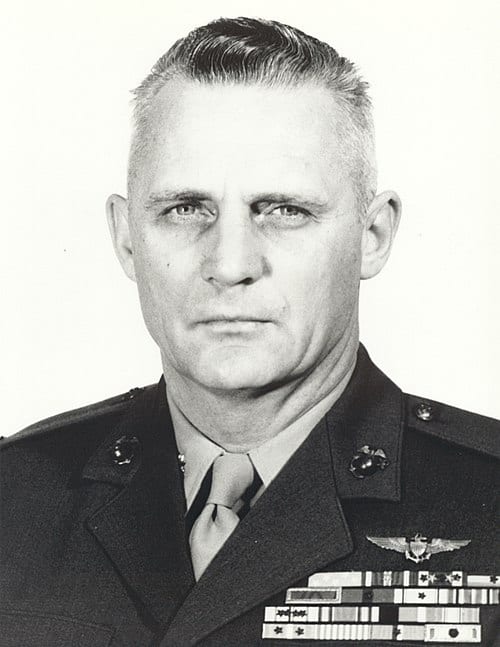
Lieutenant Colonel, U.S. Marine Corps
Support & adopt this hero ↓
Twenty-one enemy aircraft destroyed. Two desperate aerial battles against overwhelming Japanese forces. And a Marine pilot who refused to abandon the fight even after his aircraft was crippled. Lieutenant Colonel Kenneth Ambrose Walsh became one of the most successful fighter aces in United States Marine Corps history, earning the Medal of Honor for extraordinary courage in the skies over the Solomon Islands during World War II.
Kenneth Ambrose Walsh was born on 24 November 1916 in Brooklyn, New York. He enlisted in the United States Marine Corps on 15 December 1933 and began his military career as an aviation mechanic and radioman at Quantico, Virginia. Selected for flight training in March 1936, he earned his wings in April 1937 while still a private. He subsequently served in scout and observation aircraft, including assignments aboard the aircraft carriers USS Yorktown, USS Wasp and USS Ranger. After progressing through the enlisted ranks, he received his commission as a second lieutenant in October 1942.
In January 1943, Walsh deployed to the Solomon Islands with Marine Fighting Squadron 124 (VMF-124), part of Marine Air Group 12 and the 1st Marine Aircraft Wing. Flying the formidable Vought F4U Corsair, he quickly established himself as an exceptional combat pilot. His Distinguished Flying Cross citations documented a remarkable series of achievements. On 3 March and 1 April 1943, he led an attack that destroyed a Japanese schooner at Vella Lavella and personally shot down three enemy fighters. On 13 May, he intercepted Japanese aircraft over the Russell Islands and destroyed two more. Further citations recognized his twentieth mission between 29 May and 10 June, his destruction of two enemy aircraft during an escort mission to Kahili on 12 August, and his fortieth mission during operations from 17 to 19 August. A further citation for 23 August recorded two enemy aircraft destroyed during a combat air patrol over Vella Lavella. His final wartime Distinguished Flying Cross citation recognized his sixtieth mission with VMF-122 during operations in the Philippine Islands from 28 April to 12 May 1945.
Walsh's defining moment came on 15 and 30 August 1943. On 15 August, while defending Allied ground forces and shipping near Vella Lavella, he repeatedly attacked a Japanese formation outnumbering his division six to one. Despite sustaining numerous hits, he destroyed two Japanese dive bombers and one fighter. On 30 August, after engine trouble forced him to land at Munda, he quickly obtained another aircraft and rejoined his flight near Kahili. Separated from his escort group, he encountered approximately fifty Japanese Zero fighters. Rather than withdraw, he attacked alone and destroyed four enemy aircraft before cannon fire forced him to ditch off Vella Lavella. He was subsequently rescued.
For these two extraordinary actions, First Lieutenant Walsh received the Medal of Honor. President Franklin D. Roosevelt personally presented the decoration to him at the White House on 8 February 1944. His twenty-one confirmed aerial victories made him the fourth-highest-scoring Marine Corps fighter ace of World War II.
Walsh continued serving throughout the war. He worked as a flight instructor at Naval Air Station Jacksonville before returning to the Pacific in April 1945. He participated in the Philippine and Okinawa campaigns as Operations Officer of VMF-222 and later Assistant Operations Officer of Marine Aircraft Group 14. His wartime service was recognized through repeated personal decorations and American and allied unit citations, including the Navy Presidential Unit Citation, Army Distinguished Unit Citation, Philippine Presidential Unit Citation and two Republic of Korea Presidential Unit Citations.
His service did not end with World War II. During the Korean War, Captain Walsh deployed on 15 July 1950 with Marine Transport Squadron 152 and served in Korea until July 1951. His fifteenth Air Medal was recognized for outstanding performance of duty in aerial flight against the enemy in Korea, reflecting his continued contribution to Marine aviation beyond his celebrated fighter career.
In the postwar years, Walsh held aviation engineering, maintenance, operational and staff assignments, including service with the Bureau of Aeronautics and the 1st and 3rd Marine Aircraft Wings. He was promoted to major in April 1955 and lieutenant colonel in October 1958. After more than twenty-eight years of continuous active service, he retired from the Marine Corps in January 1962.
Lieutenant Colonel Kenneth Ambrose Walsh died on 30 July 1998. His legacy endures as a Medal of Honor recipient, a distinguished Marine aviator and one of the Pacific War's most accomplished fighter aces. From an enlisted aviation mechanic to a twenty-one-victory Corsair pilot, his extraordinary journey represents the courage, determination and fighting spirit of the United States Marine Corps.
Become the named supporter for this profile and edit the tribute biography and portrait (Owner account required). Proceeds help keep the archive online.
$25 USD / year — annual sponsorship renewal. Keeps the page online and, where enabled, the family anniversary remembrance emails active.