Loading archive…
Loading archive…
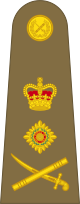
General, British Army
Support & adopt this hero ↓Garrett O'Moore Creagh was born on 2 April 1848 at Cahirbane, County Clare, Ireland, the seventh son of Captain James Creagh, a Royal Navy officer, and Grace Emily Creagh, daughter of Garrett O'Moore of Cloghan Castle, King's County. Educated at the Royal Naval School in New Cross, Kent, and subsequently at the Royal Military College, Sandhurst, he entered the British Army during the era of purchased commissions, gazetted as an ensign in the 95th (Derbyshire) Regiment of Foot on 2 October 1866. Posted to India in January 1869, he transferred to the British Indian Army in February 1870 as a lieutenant in the Bombay Staff Corps. As a nineteenth-century officer of the Indian Staff Corps commissioned prior to the implementation of systemic officer service numbering, no army service number was ever assigned to him. His early Indian service encompassed appointments with the Marine Battalion, the 25th Bombay Native Infantry, staff duties as Adjutant of the Deoli Irregular Force, and selection in June 1871 as Adjutant of the Merwara Battalion upon its transition from civil to military administration.
Promoted to captain on 2 October 1878, Creagh deployed to the Afghan border upon the outbreak of the Second Anglo-Afghan War, standing as the sole European officer present when the Merwara Battalion volunteered for active service. Attached to the Peshawar Valley Field Force, he participated in operations around Ali Musjid and in the Bazar Valley before undertaking detached tactical command along the Kabul River.
The defining action of his military career took place on 22 April 1879 at Kam Dakka. Detached from the main post at Dakka on the evening of 21 April with two companies of his battalion—numbering 150 men—to protect the village against a threatened incursion by Mohmand tribesmen, Creagh reached the settlement that night. On the following morning, an overwhelming force of approximately 1,500 Mohmands attacked the position. Discovering that the local inhabitants had joined forces with the enemy, Creagh executed a tactical withdrawal to a nearby cemetery, which he fortified into a perimeter defense. For six hours, encircled and vastly outnumbered, he maintained the position against persistent assault, repeatedly ordering bayonet counter-charges to hold the line until relief arrived at 3:00 p.m. in the form of reinforcements and a troop of the 10th Bengal Lancers under Captain D. M. Strong.
His gallantry at Kam Dakka was officially gazetted on 18 November 1879, publishing the unabridged citation for the Victoria Cross:
"On the 21st April Captain Creagh was detached from Dakka with two Companies of his Battalion to protect the village of Kam Dakka on the Cabul River, against a threatened incursion of the Mohmunds, and reached that place the same night. On the following morning the detachment, 150 men, was attacked by the Mohmunds in overwhelming numbers, about 1,500; and the inhabitants of Kam Dakka having themselves taken part with the enemy, Captain Creagh found himself under the necessity of retiring from the village. He took up a position in a cemetery not far off, which he made as defensible as circumstances would admit of, and this position he held against all the efforts of the enemy, repeatedly repulsing them with the bayonet until three o'clock in the afternoon, when he was relieved by a detachment sent for the purpose from Dakka.
The enemy were then finally repulsed, and being charged by a troop of the 10th Bengal Lancers, under the command of Captain D M Strong, were routed and broken, and great numbers of them driven into the river. The Commander-in-Chief in India has expressed his opinion that but for the coolness, determination, and gallantry of the highest order, and the admirable conduct which Captain Creagh displayed on this occasion, the detachment under his command would, in all probability, have been cut off and destroyed."
Subsequent to the Kam Dakka engagement, Creagh served as Deputy Assistant Quartermaster-General to the Kurram Field Force, seeing action at Ali Khel on 14 October 1879 and participating in the Zaimusht and Cham Kanni expeditions. Returning to regimental duty, he commanded the 44th Merwara Infantry from 1882 to 1886, receiving promotion to major on 2 October 1886. In 1890, he assumed command of the 29th (Duke of Connaught's Own) Bombay Infantry (2nd Baluch Battalion), guiding the unit through 1895 before moving into senior staff duties, including Assistant Quartermaster-General of the Bombay Command in 1896 and Political Resident and Military Commander at Aden between 1898 and 1900.
During the Boxer Rebellion in 1900, Creagh commanded the 2nd Brigade of the Indian Contingent sent to China, later serving as General Officer Commanding British Forces in China from July 1901 until 1903. His administrative and operational governance in China led to his appointment as Companion of the Order of the Bath in 1902 and Knight Commander of the Order of the Bath in 1904. Promoted to full general on 11 December 1907, he served as Military Secretary to the India Office before succeeding Field Marshal Lord Kitchener as Commander-in-Chief, India, in 1909, holding the summit military command in the subcontinent until his retirement in 1914. He was appointed Knight Grand Cross of the Order of the Bath in 1909 and Knight Grand Commander of the Order of the Star of India in 1911, alongside holding the appointment as Knight of Grace of the Order of St John of Jerusalem and receiving the Order of the Rising Sun (2nd Class) from Japan.
In private life, Creagh married Mary Letitia Longfield in 1874, who died two years later, and subsequently married Sarah Elizabeth Reade in April 1891, with whom he had a daughter and a son, Major General Sir Michael O'Moore Creagh. Following his retirement from the Indian Army shortly before the outbreak of the First World War, he served as Military Advisor to the Central Association of Volunteer Training Corps. He died at his home, 65 Albert Hall Mansions, South Kensington, London, on 9 August 1923, and was buried at East Sheen Cemetery, Richmond.
Become the named supporter for this profile and edit the tribute biography and portrait (Owner account required). Proceeds help keep the archive online.
$25 USD / year — annual sponsorship renewal. Keeps the page online and, where enabled, the family anniversary remembrance emails active.