★
Loading archive…
Loading archive…
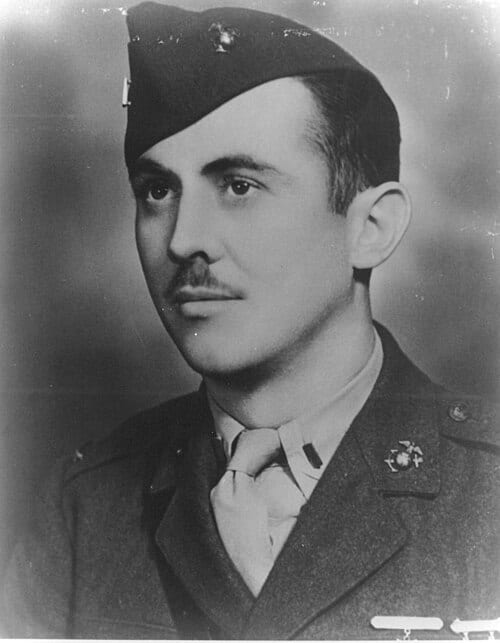
First Lieutenant, U.S. Marine Corps
Support & adopt this hero ↓
William Deane Hawkins: The Marine Who Refused to Leave the Fight
When Japanese machine guns threatened to stop the American advance at Tarawa, First Lieutenant William Deane Hawkins led from the front, repeatedly exposing himself to enemy fire to clear the path for his fellow Marines. Even after suffering serious wounds, he refused to withdraw. His extraordinary courage during the Battle of Tarawa would earn him the Medal of Honor and secure his place among the most distinguished heroes of the United States Marine Corps.
Born in Fort Scott, Kansas, and raised in El Paso, Texas, Hawkins was an exceptional student who graduated from high school at just sixteen and earned a scholarship to study engineering at the Texas College of Mines. Following the attack on Pearl Harbor, he enlisted in the Marine Corps Reserve on 5 January 1942. Assigned to the 2d Marines, 2d Marine Division, he completed scout-sniper training and deployed to the Pacific in July 1942. His leadership quickly distinguished him. He rose through the enlisted ranks before receiving a battlefield commission as a second lieutenant during the Guadalcanal campaign in November 1942. He was promoted to first lieutenant on 1 June 1943 and eventually commanded a Scout Sniper Platoon attached to the assault regiment.
His defining moment came during the assault on Betio Island, Tarawa, on 20 and 21 November 1943. Hawkins was among the first to disembark from the landing craft and immediately advanced under intense Japanese fire, neutralizing enemy positions protecting the beach. Throughout the day and night, he directed attacks against fortified pillboxes using grenades and demolitions. On the morning of 21 November, he personally led an assault against a position defended by five Japanese machine guns. Crawling forward under withering fire, he fired directly into the enemy positions and destroyed them with grenades. Despite a serious chest wound, he refused evacuation and continued the attack, destroying three more pillboxes before Japanese shellfire mortally wounded him. He died on Betio that day, aged 29.
The official Medal of Honor citation recognized his extraordinary courage, daring leadership and relentless fighting spirit above and beyond the call of duty. Awarded posthumously, the Medal of Honor was presented to his family by President Franklin D. Roosevelt on 30 August 1944. His Purple Heart recognized the wounds received in action that resulted in his death. Through his service with the 2d Marines, Hawkins also shared in the unit's Presidential Unit Citations for Guadalcanal and Tarawa, recognizing outstanding combat performance in the Solomon Islands and the Gilbert Islands. His documented campaign and wartime service awards also included the Asiatic-Pacific Campaign Medal and the World War II Victory Medal.
Hawkins's sacrifice did not end with the battle. The airfield on Betio was named Hawkins Field in his honour, and the United States Navy later commissioned the destroyer USS William D. Hawkins (DD-873), carrying his name into another generation of American naval service. His story remains a powerful testament to courage, leadership and devotion to fellow Marines. At Tarawa, he refused to abandon his men, even when the cost was his own life.
Become the named supporter for this profile and edit the tribute biography and portrait (Owner account required). Proceeds help keep the archive online.
$25 USD / year — annual sponsorship renewal. Keeps the page online and, where enabled, the family anniversary remembrance emails active.