★
Loading archive…
Loading archive…
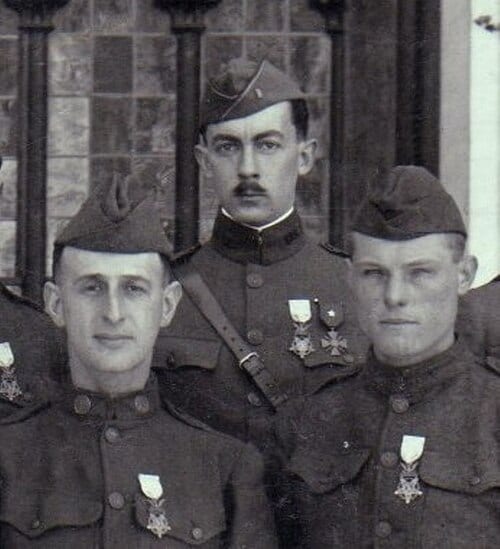
Second Lieutenant, U.S. Army
Support & adopt this hero ↓
What makes a soldier turn back toward almost certain death when he has already escaped? On 26 September 1918, amid the thunder of artillery and relentless machine-gun fire in France, Corporal Donald Marshall Call faced that extraordinary choice. His tank had been shattered by an enemy shell, and he had managed to escape. But an officer remained trapped inside. Rather than abandon his comrade, Call returned to the wreckage and carried him more than a mile through enemy fire. That remarkable act of courage would earn him the Medal of Honor, America's highest military decoration, and secure his place among the heroes of World War I.
Donald Marshall Call was born on 29 November 1892 in New York City. His military story began during one of the most devastating conflicts in modern history. When the First World War engulfed Europe, Call answered the call to service, first joining the American Field Service and serving with an ambulance section attached to French forces in 1917. There, amid the suffering of soldiers wounded on the Western Front, he encountered the human cost of industrial warfare firsthand. His experience would eventually lead him from the dangerous work of battlefield evacuation to an entirely different kind of combat, fighting inside the newly developed tanks that were transforming modern warfare.
Call subsequently served in the United States Army Tank Corps, becoming a corporal in the 344th Tank Battalion. By September 1918, American forces were engaged in major offensives against German positions in France. Tanks offered a revolutionary means of breaking through fortified defenses, but these early armored vehicles were cramped, mechanically unreliable, and dangerously vulnerable to artillery fire. Their crews operated in extreme conditions, surrounded by engine heat, fumes, deafening noise, and the constant threat of being trapped inside a disabled machine.
On 26 September 1918, during the opening day of the Meuse-Argonne Offensive, Call and an officer were operating a tank against German machine-gun positions west of Varennes, France. Suddenly, an enemy artillery shell struck the vehicle directly, tearing away half its turret. The explosion filled the compartment with choking fumes and left the tank severely damaged.
Call managed to escape and reached the relative protection of a shell hole approximately 30 yards away. But when he looked back, he realized that the officer who had been inside the tank with him had not followed.
Was the officer dead? Was he wounded? Could anyone possibly survive inside the wreckage?
Call had no way of knowing. He could have remained under cover, having already escaped a deadly artillery strike. Instead, he made the decision that would define his life.
Under intense enemy machine-gun and artillery fire, Call left his shelter and returned to the shattered tank. He found the officer alive and brought him out of the wreckage. But reaching the outside was only the beginning of their ordeal. The surrounding battlefield remained exposed to German machine guns and snipers, and safety lay more than a mile away.
Refusing to abandon his fellow soldier, Call carried the officer across that dangerous distance while enemy fire continued around them. Every step placed both men at risk. What began as a desperate return to a disabled tank became an extraordinary rescue through one of the deadliest environments of the First World War.
Call's actions demonstrated something greater than personal bravery. At a moment when survival depended on seeking shelter, he deliberately exposed himself to mortal danger to save another man's life. His courage was not the result of an order or a planned assault. It was an immediate decision to place a comrade's survival above his own.
On 9 February 1919, General John J. Pershing, commander of the American Expeditionary Forces, personally presented Donald M. Call with the Medal of Honor at Chaumont, France. The decoration recognized his extraordinary heroism during the fighting near Varennes. Call's wartime service also brought recognition from European allies, reflecting the international character of his military career and his contributions to the Allied war effort.
His story belongs to the remarkable early history of American armored warfare. During the Meuse-Argonne Offensive, the United States Army was still learning how to employ tanks on the battlefield. Soldiers like Call faced the hazards of experimental military technology while confronting an experienced and determined enemy. His Medal of Honor action remains a striking example of individual courage within the larger history of the American Tank Corps.
Call survived the First World War and lived for more than six decades after the battlefield rescue that made him a national military hero. He died on 19 March 1984 in Bethesda, Maryland, at the age of 91. His cremated remains were placed in a flower garden, a quiet resting place for a man whose name had become associated with extraordinary courage under fire.
Today, Donald Marshall Call is remembered as a World War I Medal of Honor recipient whose heroism was measured not by the number of enemies he defeated, but by the life he refused to leave behind.
His legacy raises a timeless question: What does true courage look like when no one would blame you for saving yourself?
For Corporal Donald M. Call, the answer came on a battlefield in France. He had escaped the wreckage. He had reached safety. Yet when he realized another man remained in danger, he turned around.
And that decision made him a hero.
Medal of Honor citation
During an operation against enemy machine-gun nests west of Varennes, Cpl. Call was in a tank with an officer when half of the turret was knocked off by a direct artillery hit. Choked by gas from the high- explosive shell, he left the tank and took cover in a shellhole 30 yards away. Seeing that the officer did not follow, and thinking that he might be alive, Cpl. Call returned to the tank under intense machine-gun and shell fire and carried the officer over a mile under machine-gun and sniper fire to safety.
Become the named supporter for this profile and edit the tribute biography and portrait (Owner account required). Proceeds help keep the archive online.
$25 USD / year — annual sponsorship renewal. Keeps the page online and, where enabled, the family anniversary remembrance emails active.